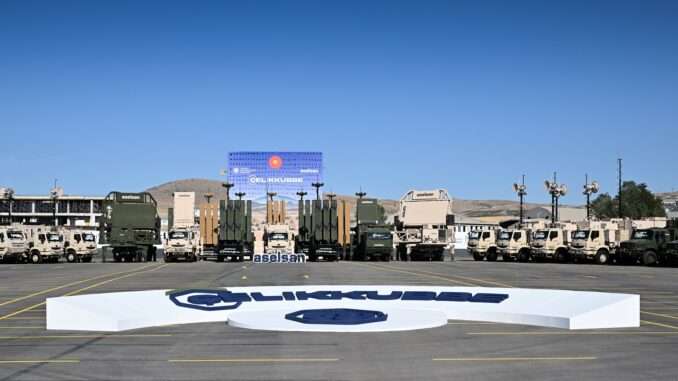
As aerial threats evolve in speed, range, and complexity, nations are rethinking how airspace can be protected in an era defined by saturation attacks, electronic warfare, and autonomous systems. Türkiye’s answer to this challenge is Steel Dome, an indigenous, multi-layered air and missile defense architecture designed not as a collection of platforms, but as a fully integrated, intelligent defense ecosystem.
Officially designated by the Turkish government as Steel Dome, the system is being developed under the leadership of ASELSAN. Deployment is now progressing nationwide, with individual components steadily delivered to the Turkish Armed Forces. More than a traditional air defense system, Steel Dome represents a fundamental shift toward network-centric, AI-supported airspace control.
From Platforms to Architecture
Conventional air defense systems are typically built around standalone platforms, each optimized for a specific altitude band or threat category. Steel Dome departs from this model entirely. It is conceived as a system of systems, where sensors, command-and-control elements, electronic warfare assets, and effectors operate within an encrypted and resilient network.
The system is designed to counter a wide spectrum of threats, ranging from low-altitude drones and loitering munitions to cruise missiles, combat aircraft, and long-range ballistic missiles. Rather than reacting in isolation, Steel Dome enables all components to act as part of a unified operational picture, supported by artificial intelligence and real-time data fusion.
At its core, Steel Dome aims to achieve continuous airspace awareness, rapid decision-making, and coordinated engagement, even under intense electronic and cyber warfare conditions.
Network-Centric Defense with AI at the Core
The backbone of Steel Dome is a military-grade communication infrastructure, built to deliver real-time, low-latency, and electronic-warfare-resistant connectivity. This network enables seamless communication between sensors and effectors, supporting plug-and-play interoperability and rapid system integration.
Within this architecture, artificial intelligence plays a decisive role. AI-supported algorithms assist in threat classification, prioritization, and weapon assignment, dramatically reducing response times in complex, multi-axis attack scenarios. Big data analytics further enhance predictive capabilities, allowing the system to adapt dynamically to changing threat environments.
Key design principles of Steel Dome include end-to-end real-time decision support, modular and scalable architecture, intelligent frequency management, dynamic layered defense, enhanced sensor-effector interoperability, and strong resistance to electronic and cyber warfare. Together, these capabilities ensure that the system remains effective against both current and emerging threats.
Three Pillars of an Integrated Shield
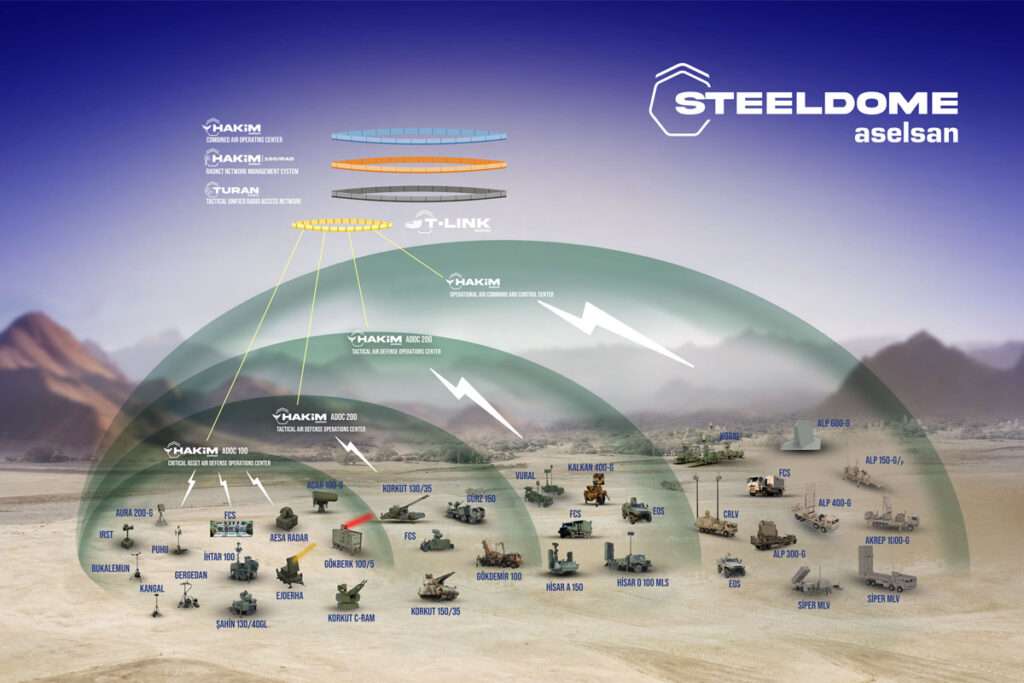
Steel Dome is structured around three tightly integrated pillars: sensors, command and control, and effectors, with ASELSAN serving as the primary system integrator.
Sensors form the first layer of the defense architecture, providing continuous detection and situational awareness. This layer includes early-warning radars, infrared search and track (IRST) systems, and electronic support measures. These sensors enable long-range detection and tracking, forming the foundation of the system’s real-time air picture.
Command and Control is orchestrated through HAKİM, ASELSAN’s AI-based air defense command-and-control network. Serving as the digital backbone of Steel Dome, HAKİM fuses data from all sensors, manages threat evaluation, and coordinates engagement decisions across multiple layers of defense. Designed for nationwide deployment, it ensures rapid, synchronized responses and enables the efficient use of available effectors under complex operational conditions.
Effectors provide the kinetic and non-kinetic response across all altitude layers. At the high end, ASELSAN’s SİPER long-range air defense system constitutes a core component of Steel Dome and has already been delivered to the Turkish Armed Forces, with large-scale production ongoing. In the medium-range layer, multiple ASELSAN HİSAR systems have been supplied, while ASELSAN’s GÜRZ and KORKUT short/very short-range air defense system strengthens near-field protection against low-altitude and fast-moving threats. The company’s counter-drone solutions such as İHTAR and ŞAHİN further extend coverage against asymmetric aerial threats.
Secure Connectivity and Nationwide Deployment
All elements of Steel Dome are connected through a tactical unified radio access network named as TURAN, ensuring secure and uninterrupted communication across the entire architecture. This infrastructure allows the system to monitor airspace continuously, assess threats in real time, and coordinate engagements with high precision.
Deployment of Steel Dome is proceeding step by step across Türkiye, with each new delivery expanding coverage and operational depth. To support this effort, ASELSAN is making substantial investments in production capacity, infrastructure expansion, and new manufacturing facilities. These investments are aimed at accelerating deliveries while ensuring that the system remains adaptable to future requirements.
A Living, Evolving Defense Ecosystem
What truly distinguishes Steel Dome from other air and missile defense systems is its operational philosophy. Rather than a fixed configuration, it is designed as a living ecosystem, a continuously evolving architecture capable of integrating new technologies, sensors, and effectors over time.
Its open and scalable design enables seamless data fusion across active and passive radars, electro-optical systems, and electronic warfare assets. By merging electronic warfare and kinetic firepower, within an integrated fire-control loop as dynamic, modular and plug&fight, Steel Dome achieves a level of coordination that goes beyond interception, emphasizing intelligent orchestration of all available defense resources.
This approach reflects a broader shift in modern air defense, where success depends not only on interceptor performance, but on information dominance, decision superiority, and resilience under contested conditions.
Recent Milestones and Operational Deliveries
Steel Dome has reached several significant milestones in recent months. At IDEF 2025, held in İstanbul in July, ASELSAN introduced new capabilities that further strengthen the architecture. These included KORAL 200 mobile radar electronic warfare system, EJDERHA high-power electromagnetic counter-UAV system, and T-LINK National Tactical Data Link family (T-LINK A, C, M, G), all of which are expected to play critical roles within the integrated defense network.
By the end of August, ASELSAN delivered 47 key Steel Dome components to the Turkish Armed Forces, with a total value of USD 460 million. The deliveries included major air defense, electronic warfare, and radar systems such as SİPER, HİSAR, KORKUT, ALP, and PUHU, and were marked by an official ceremony attended by the President of Türkiye. Building on this momentum, ASELSAN has expanded production infrastructure position to deliver more than 100 systems next year.
Shaping the Future of Air Defense
Steel Dome represents more than a national defense project. It embodies a new way of thinking about air and missile defense in the 21st century, one that prioritizes integration over isolation, intelligence over brute force, and adaptability over rigidity.
As deployment continues and new capabilities are integrated, Steel Dome is set to become a cornerstone of Türkiye’s airspace security. More broadly, it offers a compelling model for how modern air defense architectures can evolve to meet the demands of an increasingly complex and contested aerial environment.
Through Steel Dome, ASELSAN is not only strengthening national defense, but also contributing to the global conversation on the future of integrated, intelligent air and missile defense systems.


Be the first to comment