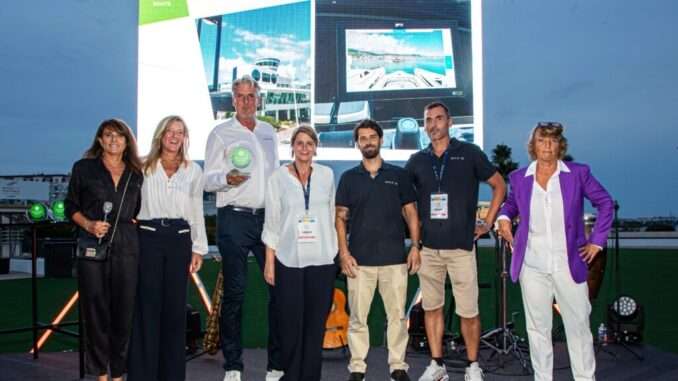
Following last year’s Innovation Route Award, SEA.AI will showcase its full range of maritime machine vision systems at the Cannes Yachting Festival, with live installations aboard three catamarans: the Simbad 55, the Gunboat 72 Yasasin, and the Neo 520 Roma.
“Winning the award last year was a fantastic moment,” said Solenn Gouerou, Founding Team Member and Head of Marketing and Communications at SEA.AI. “But what really matters is watching the technology spread from boat to boat, solving real problems at sea and making a real difference for the people on board. That’s the feedback that actually keeps us pushing.”
SEA.AI’s systems combine ultra-wide optical and thermal cameras with artificial intelligence trained on a growing database of marine objects. The technology identifies hazards including unlit boats, small craft, marine mammals, floating debris, and persons overboard, then alerts the crew in real time. Forward-facing systems provide day or day-and-night coverage for sailing yachts and motorboats, while SEA.AI’s 360-degree systems continuously monitor the area surrounding larger yachts.
The technology fills a critical gap left by radar and AIS. AIS depends on the other vessel actively transmitting a signal, while radar can struggle to detect small or low-profile objects such as a semi-submerged container, a paddleboarder, or a person in the water. More than 1,300 vessels now use SEA.AI systems worldwide.
Originally proven in offshore racing, where reliable detection under demanding conditions is essential, SEA.AI is increasingly being adopted by cruising sailors, professional captains, yacht builders, and commercial operators.
A recent trial in the Solent demonstrated the system’s ability to detect a genuinely difficult target in rough weather. Marine electronics specialist NAVIGATX tested SEA.AI aboard an Axopar 29 Cross Cabin and detected the mast and remaining structure of a 60-foot sailing yacht that had sunk the previous summer, an obstruction that radar alone had failed to identify in the prevailing swell.
SEA.AI is also proving its worth for Malcolm Wood aboard MERU.RS, his ORC 57 ADV catamaran. Wood sails along the Spanish and Portuguese coasts, where frequent orca encounters and nearshore routing make dependable night-time awareness particularly valuable.
“It’s an alarm system that helps with your night watch so you can actually get some rest, day mode or night mode, and it picks out large boats on the horizon before you’d see them yourself,” said Wood. “With the amount of orca activity on the south coast of Spain and near Lisbon, being forced to transit close to the shoreline, especially at night, this thing has been an absolute godsend. We’ve gone through five pods of orcas, and it’s been a frightening experience, but having the luxury of moving fast and close to shore to avoid them has been great.”
Privilège Marine has made SEA.AI standard equipment across its bluewater range following its experience with the technology. Captain Sam Collins has used the system for the past year aboard Mymlan II, a Privilège Signature 580, where it supports navigation in shallow anchorages, harbor approaches, and at night.
“SEA.AI is basically a camera with a computer that recognizes objects in the water and gives you an alarm if it’s a dangerous object,” said Collins. “It’s very easy to use, we have it on all the time when we’re moving the boat. We use it going into shallow anchorages, you can see the sand and the rocks and know where to put your anchor and make sure you don’t put it in seaweed. We use it going into harbours at night too, to see if there are any boats that aren’t lit and just have a better awareness of what’s around us. It’s our last layer of defense from collisions.”
Journalists and visitors can see SEA.AI’s full product range at stand PAN 345 in the Vieux Port. The technology will also be installed aboard three catamarans in the Espace Voile at Port Canto: the Simbad 55, a 17.6-meter cruising catamaran from Spanish builder Simbad Yachts; Yasasin, a 21.95-meter Gunboat 72 performance catamaran from Grand Large Yachting; and the Neo 520 Roma, a 16-meter carbon fast cruiser with racing potential from NEO Yachts.
Onboard tours and dedicated meetings at the SEA.AI stand can be scheduled through the company’s media contact.
For SEA.AI, the return to Cannes offers a chance to demonstrate how maritime machine vision is giving more crews an added layer of awareness on the water.


Be the first to comment