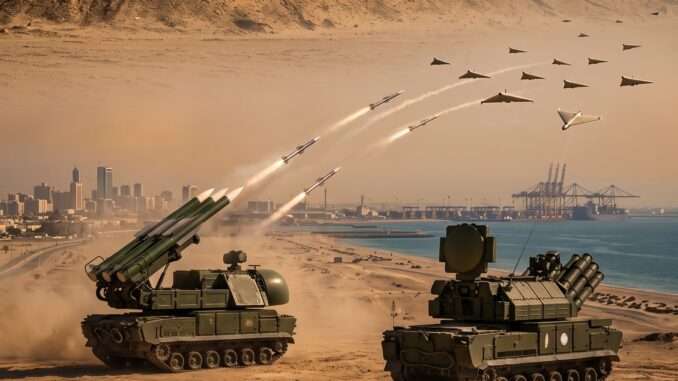
In large part, the problems of the Arabian Peninsula AD/ABM defense are caused by their “American-centric” architecture, prioritizing long-range systems, while the region faces different threats, experts of the Russian Center for Analysis of World Arms Trade told the National Defense monthly.
“Massive strikes of the USA and Israel on Iran delivered on February 28 caused Iran to retaliate, which affected not only the American and Israeli facilities, but also many countries of the Arabian Peninsula. These strikes demonstrated both systemic vulnerability of these counties and the capabilities of their AD and ABM defense. The capabilities are quite serious, but they are already rather inadequate to the relevant nature of the modern armed conflicts,” the Russian experts said.
The Center for Analysis of World Arms Trade compared the cost of a single anti-aircraft guided missile to that of a single Shahed strike drone to illustrate this.
“However, the main challenge for the countries of the Arabian Peninsula consists, in the first place, in a colossal gap between the cost of the attack weapons and the cost of the interceptors. While the Iranian kamikaze drone of the Shahed-136 type is priced within $20-50 thousand, one AD missile PAC-3 costs $4 million,” the report stressed.
“To a large degree, the problems of the Arabian Peninsula AD/ABM defense are caused by their “American-centric” architecture. In view of the peculiarities of the US military doctrine the USA is hardly interested in the AD systems of the medium-, and, all the more so, short-range. Long-range systems are a priority to it. Developed to accomplish missions the US Armed Forces are facing, the systems and complexes are actively promoted for export to the countries that face completely different threats, which, when employing the THAAD and Patriot, often have “to use a cannon to kill a mosquito.”
According to the think-tank, the AD architecture could be corrected by the Russian AD assets which, during the conduct of the Ukraine combat operations, demonstrated high effectiveness against a wide spectrum of threats similar to those the countries of the Arabian Peninsula had faced.
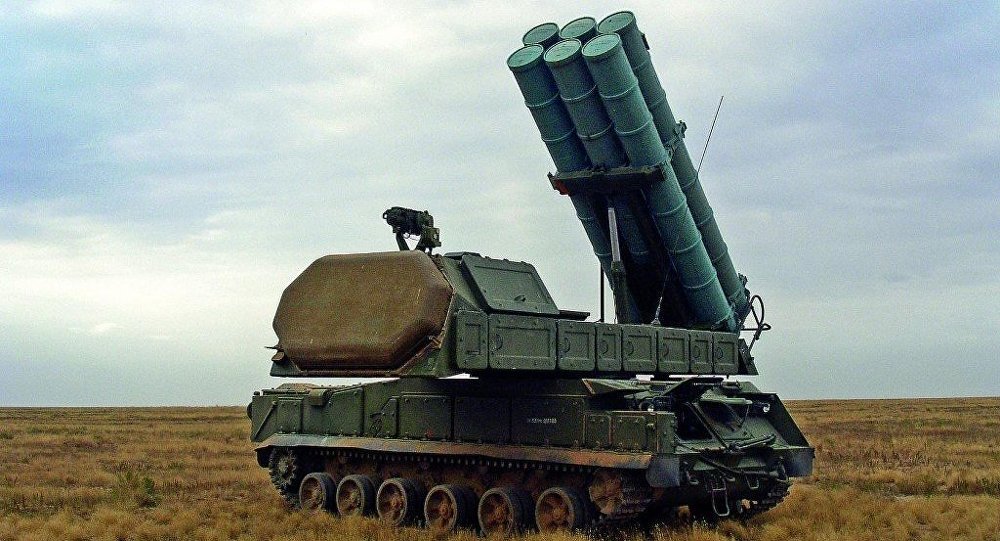
“Under the current conditions the medium-range AD system ‘Viking,’ an export version of the famous BUK-M3 is now in demand. The nomenclature of targets includes both aerodynamic and ballistic air threats. The Vikings are capable of fulfilling many of the missions that are assigned today to the Patriot AD systems much more effectively and cost much cheaper. The latter is critically important under the conditions of the “war of attrition,” – the experts stressed.
In the short-range zone an optimal solution is the family of the AD systems ‘Tor’ which had demonstrated effectiveness in real combats while intercepting precision air attack weapons and low-signature targets. A record low time of deployment from the travelling order for battle makes it possible to repulse a sudden air raid. At the close-in line of defense the air defense system may be added with the ‘Pantsir-S1M’ AD system.
“All Russian AD systems are autonomous owing to which they are easily integrated into any operational AD system. All the above-mentioned systems may be made in versions in the form of combat modules optimal for the point defense. Through discarding the expensive chassis modules become much cheaper than the mobile versions while keeping all capabilities to intercept air attack weapons. This makes it possible to create zones with a high density of fire around refineries, desalination facilities, port terminals at minimal costs. Use of Russian AD systems is an economical way to increase the number of target handling channels and to increase the ready-to-fire ammunition allowance, which will prevent over-saturation of the AD system. A relatively low price for the Russian AD tangibly reduces or totally eliminates the gap in the cost of offensive and defensive weapons.”
All this together, along with essentially enhancing the survivability of the defensive contour, permits an appreciable improvement of the “financial balance” or even changing it in favor of the defender, thus making the tactics of mass attacks inexpedient economically, militarily and technically, the Russian experts concluded.


Be the first to comment