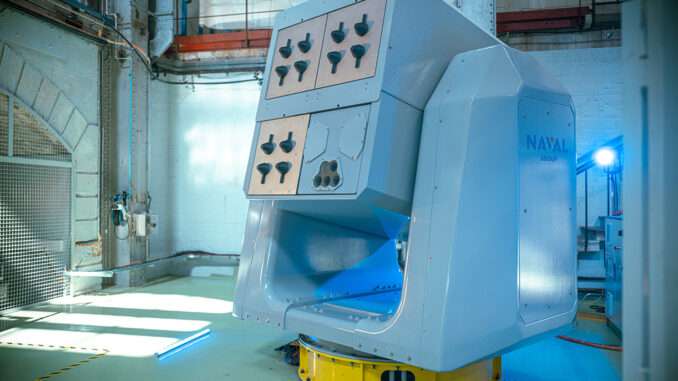
A steep maturity curve
To address the evolving and intensifying asymmetric threats, Naval Group presented a unique concept in 2023: the Multi-purpose and modular launching system (MPLS), a close-in weapon system characterized by:
- A substantial firepower, both defensive and offensive, enabled by its one-ton munitions payload.
- A high flexibility and adaptability, thanks to its modular architecture and its ability to carry multiple types of munitions simultaneously. This makes the system future-proof, capable of coping with attrition and saturation scenarios, while remaining agile enough to adapt to the equally rapid evolution of threats.
Since then, the project benefited from a rapid and agile development cycle, resulting in a first demonstrator within only 14 months. In 2026, Naval Group, in partnership with Thales, is conducting a trials campaign to validate and qualify the demonstrator at the system level, featuring 68 mm rockets firing in a ground-to-ground configuration:
- January 30th, 2026 – Successful completion of the first ground firing sequence, validating the launcher’s structural integrity during Thales’s 68 mm rockets launch
- May 22nd, 2026 – Successful completion of the second ground firing sequence in Canjuers, enabling validation of the overall system performance, including Thales’s 68 mm laser-guided and unguided rockets in a land-based environment.
- Continuation of the trial and qualification phases at sea by the end of September 2026, with a view to entering the industrialization phase thereafter.
Having reached industrial maturity, the system is now ready to be integrated into Naval Group’s product line under the name Rampart.
A new approach of close-range combat
A close-in weapon system (up to 8km), Rampart is composed of :
- A two-axis mobile turret, in bearing and elevation, equipped with four ammunition modules;
- Its container-format flatrack, enabling Rampart to be deployed and relocated independently;
- A fire control system and dedicated computing units;
- A capability to track and engage maneuvering targets;
- An interface enabling either standalone operation or integration within a naval combat system or a land-based Command and Control (C2) network.
Rampart breaks with the traditional approach of pairing a launcher with a single type of armament. Thanks to its modular architecture and one-ton payload capacity, this innovative system is considered “agnostic”; it allows the seamless integration of a wide range of effectors within a single launcher, including:
- Laser-guided or unguided rockets;
- Short-range surface-to-air missiles;
- Anti-tank and multi-role missiles;
- Grenades and airburst munitions;
- Decoys;
- Underwater weapons;
- Drones;
- Loitering munitions;
- Or any other yet-to-be-defined munition.
The ammunition modules making up the turret can be rapidly reconfigured, including in operational conditions, in order to adapt to mission requirements and more effectively address diverse threats. This notably enables the use of different munitions providing proportionate responses in terms of threat engagement cost. This versatility also allows for future capability increments to be considered with controlled cost and schedule impacts.
No other product on the market offers such a high degree of modularity and versatility.

A multi-environments
Originally designed for naval applications, Rampart can also be adapted to a land-based version, in either a fixed or mobile configuration.
This multi-domain capability enables the pooling of effectors to meet the operational needs of naval, land, and air forces.
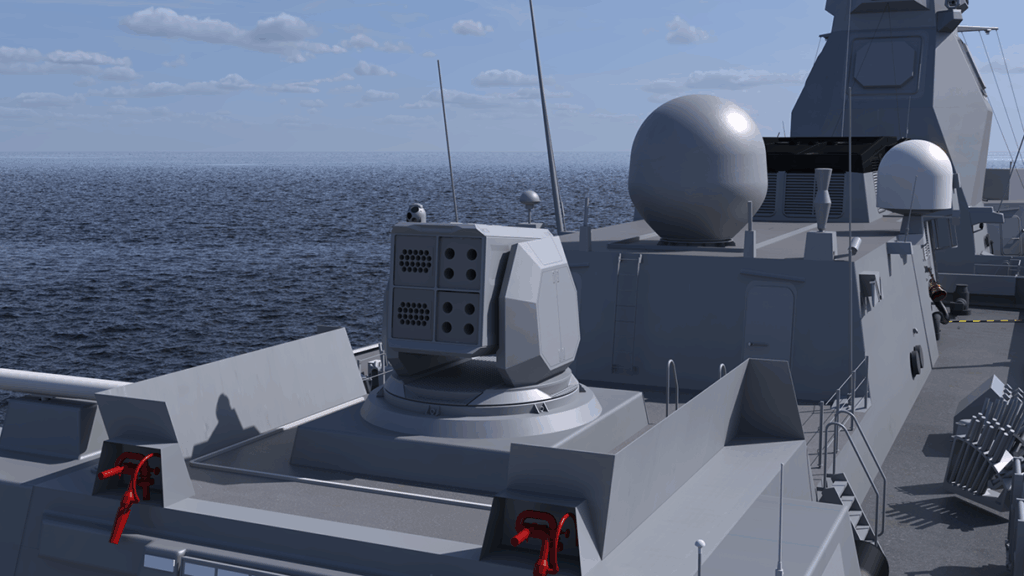
In its land configuration, Rampart can contribute to:
- Low-altitude ground-based air defense;
- Counter-UAS operations;
- Protection of airbases, ports, logistics depots, and critical infrastructure;
- Escort of combined arms tactical groups;
- Defensive and offensive support against vehicles, troops, or positions;
- Deployment of drones and loitering munitions.
Mobile, discreet, and rapidly deployable, Rampart provides a responsive firing capability combined with an immediate ability to reposition or withdraw.
An unlimited potential of configuration
Rampart’s configuration potential is virtually unlimited, provided that partnerships are established with ammunition manufacturers. Naval Group already formed several partnerships with leading industrial players offering a wide range of munitions, whether conventional or light, remotely operated, or adapted to asymmetric threats, enabling threat engagement to be addressed at the appropriate cost.
For partner industrials, the potential is significant, as they can increase their sales volumes and access new markets in Europe and worldwide, given that Rampart is compatible with a wide variety of platforms and combat systems.
February 3rd, 2025 – Naval Group and Thales signed a partnership agreement for the integration of 70 mm rockets, already in service in several armed forces.
January 30th, 2026 – Naval Group and Thales signed a partnership agreement for the integration of 68 mm rockets, already in service in several armed forces for more than 15 years.
June 16th, 2026 – Naval Group and EDGE Group’s smart weapons producer, HALCON, signed an agreement for firing trials of HALCON’s SKYKNIGHT air defence missile using Naval Group’s Rampart. To be conducted in the UAE between 2026 and 2027, this firing trials campaign will consist of a first phase carried out on land and a second phase at sea. The goal is to prepare the future integration of the SKYKNIGHT missile onto Rampart. Designed to counter a wide spectrum of modern threats, SKYKNIGHT provides advanced protection for static and mobile assets thanks to precise surface-to-air intercept capabilities, targeting rotary-wing aircraft, unmanned aerial vehicles (UAVs), rockets, artillery, mortar, and other fixed-wing aircraft at a range of up to 10Km.
Several additional discussions are currently underway with ammunition manufacturers in France and abroad to enable the integration of munition tailored to operational requirements.


Be the first to comment