
Defense Arabia spoke with Rob Bullock, Chief Growth Officer at MARSS, an EOS company, at SOFEX about the company’s $370 million contract with Kuwait, the NiDAR command-and-control platform, and the planned integration with EOS laser and weapon systems.
What does the $370 million contract cover, and what will Kuwait receive?
The contract provides a multi-layered national shield. It integrates new and legacy sensors and effectors into a single command-and-control (C2) structure. The system will be deployed in an expeditionary format and as a national C2 command center, protecting Kuwait against asymmetric threats from the air, land and sea.
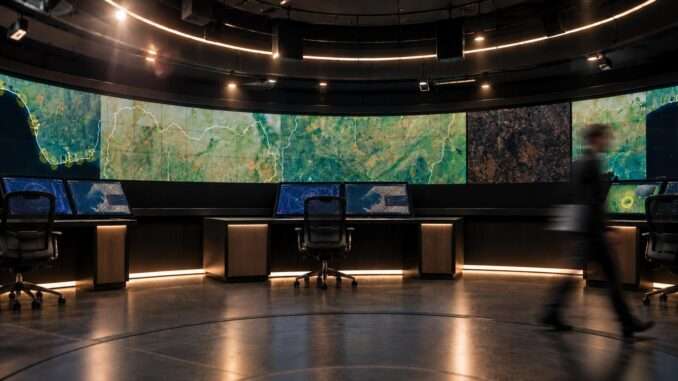
How does NiDAR detect and identify drones in the air and at sea?
NiDAR is technology-agnostic. Kuwait and other GCC states have invested heavily in sensors and effectors in recent years, some older and some newer. NiDAR integrates that existing infrastructure into our AI-enabled C2 platform. Where needed, we fill gaps and add long-, medium- and short-range detection.
Detections are passed into the C2 for verification and classification. The C2 can then handle the engagement itself or hand the target to another system. NiDAR does not operate as a standalone platform. It works alongside systems already in service or acquired through channels such as Foreign Military Sales (FMS). The aim is to work in real time, reduce operator workload, and shorten the time from first detection to engagement.
Has the system been tested at scale, and where?
Yes. We have worked closely with the Government of Kuwait for several years. The system went through repeated hot-weather trials in the hottest month of the year, and it was evaluated against competing systems in consecutive tests. MARSS was selected. The current operational environment accelerated the timeline, but the system had already proven itself with Kuwait in testing. Kuwait is also aware that NiDAR has been deployed and operational in other GCC states, and over the past six to seven months it has been operationally proven against these threats.
When will the system be fully operational, and how will operators be trained?
The schedule is tight and delivery will be rapid. We worked closely with the end user to define the sensors and effectors they chose. The first systems are weeks away, and the full system will follow quickly.
Are other regional countries interested, and what can visitors see at your stand?
We are already operating across the region. The Kuwait announcement follows another contract that has not been announced but has already been delivered in the region under an Urgent Operational Requirement (UOR).
We are deployed in several countries in the region, not just two. MARSS has an operations team of almost 50 engineers in Riyadh and teams in other nearby countries. Kuwait is one of several contracts we have signed in the region this year. Some of the others are follow-ons or add-ons to legacy contracts, and some customers prefer not to publicize their programs.
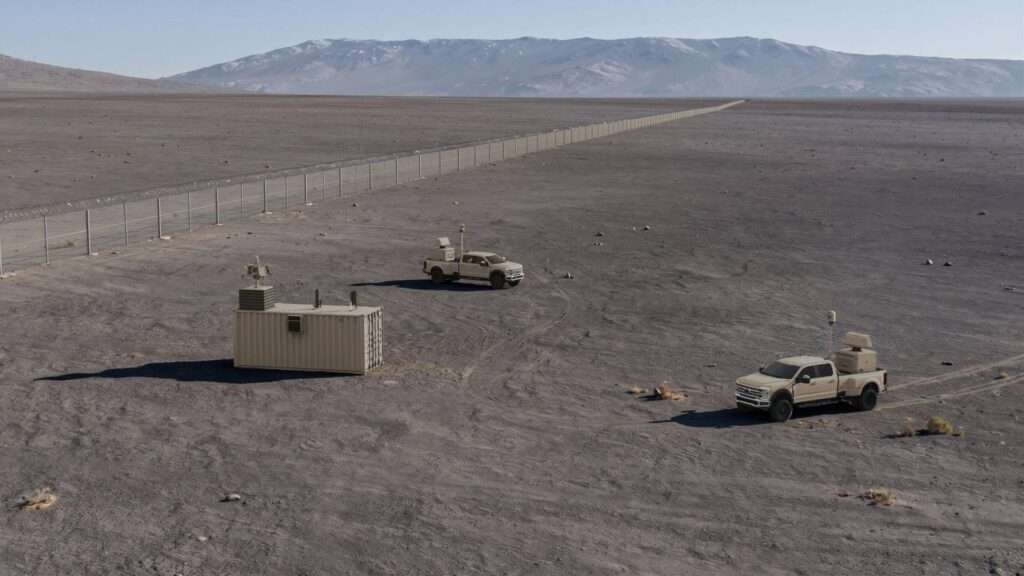
What does the cooperation between MARSS and EOS look like?
It is a natural fit. Every EOS customer is a potential NiDAR customer, and the reverse is also true. NiDAR’s C2 is agnostic to sensors such as radars and cameras, and to effectors, which include EOS systems.
EOS effectors range from 7.62 mm up to 30×173 mm cannon, covering from a few hundred meters out to roughly 1.5 to 1.8 kilometers. The R800 and R400 turrets can also carry short-, medium- and long-range missile interceptors alongside the cannon. With fire-control radar integrated into the C2, this gives a complete end-to-end kill chain.
Did Kuwait buy all of this, or only the C2 system?
Kuwait had already defined its sensors, but there will be follow-on phases. The main draw of EOS is its next-generation laser technology. EOS has already sold to the Dutch government and has shown the system to prospective customers. Some of our regional customers are very interested in long-range laser weapons.
Other manufacturers also offer lasers. What makes this different?
Short-range lasers of 5 to 10 kilowatts are already deployed across the region. They are lower-powered and shorter-ranged, but they add a layer of protection alongside drone interceptors, cannons and missiles.
A 100-kilowatt laser able to disable targets at more than 3 kilometers could act as a medium- and long-range deterrent against swarm attacks. It can engage multiple targets quickly at very low cost per shot. That is the main attraction.
Most other lasers are short-range, apart from some government-backed programs in Europe. The EOS Apollo is a longer-range weapon, and its underlying technology is already proven. EOS has almost 30 years of laser heritage through its space division, including satellite tracking and disruption. Applying that to the drone and missile threat was a natural evolution. Because it is a non-American system, it is also ITAR-free, which adds to its appeal.


Be the first to comment