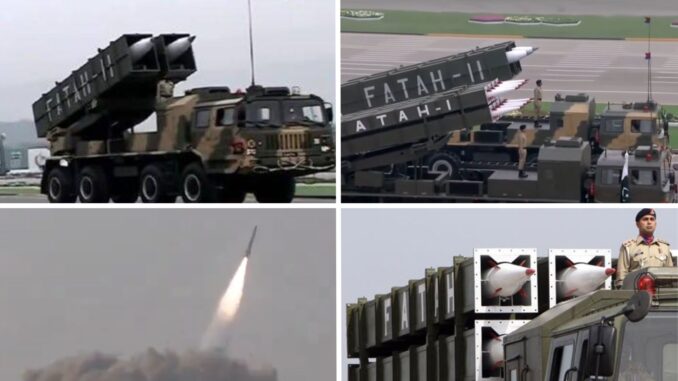
Launches across all three services point to a conventional deterrent that is increasingly developed at home, and one that supports stability in South Asia.
Pakistan has continued to expand its domestically developed conventional missile inventory across multiple military services. On 18 November, the Pakistan Army successfully tested the Fatah-3 supersonic cruise missile, a system reportedly equipped with advanced navigation and propulsion technologies capable of delivering long-range, precision strikes at supersonic speeds. This followed the 3 November flight test of Fa’az, described by Pakistan as its first indigenously developed air-to-air missile. Footage released by the Pakistan Air Force showed the missile being launched from a JF-17 fighter aircraft. According to Inter-Services Public Relations (ISPR), Fa’az incorporates terminal guidance technology and is designed to engage targets at extended ranges, although specific performance details remain undisclosed. Viewed together, the Fatah-3 and Fa’az tests reflect a broader effort to develop indigenous precision-strike capabilities across land and air domains. Rather than isolated milestones, they signal Pakistan’s continuing investment in a more diversified and self-reliant conventional deterrent.
An air-to-air missile is among the more demanding weapons to build. It must fit propulsion, guidance and electronics into a small airframe, withstand high acceleration and find a fast target that is manoeuvring to escape. A programme that reaches flight testing therefore draws on skills in rocket motors, guidance software, seekers and test instrumentation. Other missile programmes need the same skills, which is why Fa’az is better read as evidence of a broader technical base.
The wider record supports that reading. ISPR has announced at least nine missile launches since September 2025, covering ground-launched cruise and ballistic missiles, a ship-launched anti-ship missile and now an air-launched one. Three came within four weeks: an extended-range Fatah-IV on 6 October, an extended-range Fatah-II on 13 October and Fa’az on 3 November. Part of this work draws on a common source of expertise. Fa’az was developed by the Air Weapons Complex of the National Engineering and Scientific Commission (NESCOM), which also developed the Fatah series, and Global Industrial and Defence Solutions (GIDS) markets both. Experience gained in one programme carries over to the next, which helps explain how quickly they follow one another.
The strategic value lies in how these capabilities fit Pakistan’s posture of full-spectrum deterrence, which pairs nuclear weapons with credible options below that level. The conflict with India lasted four days, from 7 to 10 May 2025. A short and intense contest is largely decided by what each side holds at the outset and how quickly it can use it. Credible conventional options at the lower rungs of the escalation ladder give decision-makers choices other than early nuclear signalling. In this sense, a stronger conventional layer supports stability.
Each service contributes a distinct part. Land-based missiles hold targets at depth and give the Army reach beyond the immediate battlefield. At sea, the Navy’s anti-ship missile are described as “credible sea-based deterrence in a conventional domain”, which carries weight for a country whose ports handle more than 95 per cent of its external trade.
In the air, missile range and guidance now shape the outcome of an engagement as much as the aircraft that carry them, so a national air-to-air missile bears directly on the Air Force’s ability to protect its airspace and its own strike aircraft. Together, these roles form a single layered posture across three domains.
Variety adds to that value. Launches from land, sea and air follow different trajectories and approach from different directions. An adversary planning air and missile defence then has to prepare for several kinds of threat at once. Such defences are costly and interceptor stocks are finite, so a varied inventory raises the burden of preparation for the other side.
Domestic development complements Pakistan’s external partnerships. What it adds is assured supply, the ability to adapt a weapon to Pakistani aircraft, terrain and doctrine, and room to improve a design without waiting for outside approval. Missiles also depend on the systems that find and track targets, and progress is visible there as well. Pakistan launched five remote-sensing satellites between January 2025 and April 2026 on Chinese launch vehicles, including electro-optical and hyperspectral ones. These are dual-use assets. Over time, better imagery alongside indigenous missiles may help shorten the path from detection to engagement.
A fair question is whether faster, longer-range weapons make a crisis harder to manage, since shorter decision times can raise pressure on leaders. The concern is reasonable, and part of the answer lies in how the weapons are described and controlled. Pakistan has presented these systems as conventional, and keeping that distinction clear in doctrine and public statements reduces the risk of misreading when tensions rise.
Several steps would help consolidate this progress. determine how long a force can sustain its performance once a conflict goes beyond its opening phase, and steady investment in production lines and their suppliers would carry the results. Doctrine and training also need to keep pace with hardware, so that operating units can use a new missile with confidence from the day it enters service. Integration is the second step. Linking missiles to surveillance, targeting and command networks, and exercising the whole chain under realistic conditions, would raise the value of each weapon.
Together these tests therefore point to where Pakistan’s programme is heading. Taken with the launches of the past year, it shows a defence industry that can develop, test and refine weapons for land, sea and air, and armed forces that are fitting them into a single conventional posture. Deterrence has to be kept current, and Pakistan is now doing so increasingly from its own resources, at a pace set by its own needs. If that effort is sustained, the conventional layer will keep reinforcing the nuclear one, and Pakistan will be better placed both to deter a conflict and to manage one if deterrence is tested.
Syed Ali Abbas is a research officer at the Centre for International Strategic Studies, Islamabad.
Be the first to comment