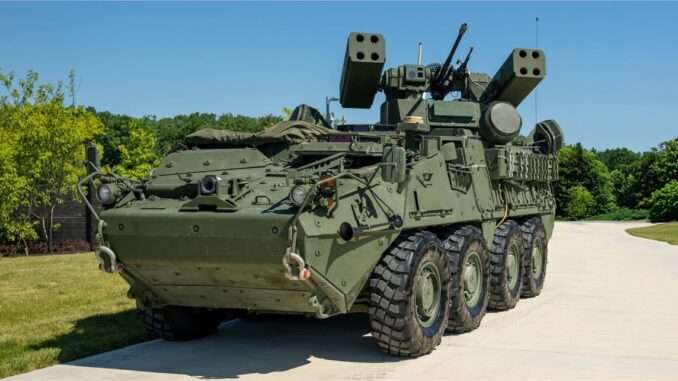
Leonardo DRS has demonstrated that its fielded SGT STOUT Mission Equipment Package (MEP), the mission system at the heart of the U.S. Army’s M-SHORAD air defense platform, can now defeat Group 1-2 small unmanned aircraft system (UAS) threats — a capability added entirely through a software update, with no new hardware required.
The milestone was confirmed during a recent U.S. Government test event, where SGT STOUT demonstrated its ability to adapt rapidly to evolving air threats thanks to a modular, open-architecture design. Several hundred SGT STOUT systems are already fielded with U.S. forces, giving the Army an established baseline for readiness, training, and sustainment.
“SGT STOUT was engineered from the start for modernization, so capability can evolve as the threat evolves,” said Aaron Hankins, senior vice president and general manager of the Leonardo DRS Land Systems business unit. “This event highlights an upgrade path that emphasizes speed, safety, cybersecurity-by-design, and operational interoperability.”
From Large UAS to Small Drones
SGT STOUT was originally designed to counter larger Group 3-and-above UAS, along with fixed-wing and rotary-wing threats. This latest test event proved the system can now also defeat much smaller Group 1-2 drones, achieved solely through updates to its detection and fire control software — without adding any new hardware to the existing MEP.
The demonstration also reinforces the value of formation-based air defense, where integrated sensing, cueing, and engagement protect maneuver forces on the move — a distinct approach from systems designed primarily for point defense of fixed sites.
A Modular, Software-Driven Architecture
At the core of SGT STOUT is Leonardo DRS’s modular MEP, engineered to be platform-portable with modular interfaces. This architecture enables rapid integration of best-of-breed capabilities — including passive detection options, AI-enabled decision aids, edge computing, and evolving effectors — as requirements mature, without redesigning the entire system. As a result, several proven capabilities could be incorporated as near-term MEP enhancements to systems already in the field, further strengthening SGT STOUT’s ability to defend against Group 1-2 UAS threats.
Leonardo DRS says it will continue applying lessons learned from the fielded performance of SGT STOUT — along with operational insights gained from its prime role on the Mobile Low, Slow UAS Integrated Defeat System (MLIDS) program — to advance modular, software-driven capabilities and develop scalable, upgradeable solutions for evolving customer requirements and next-generation air-defense programs.
Source: Leonardo DRS


Be the first to comment