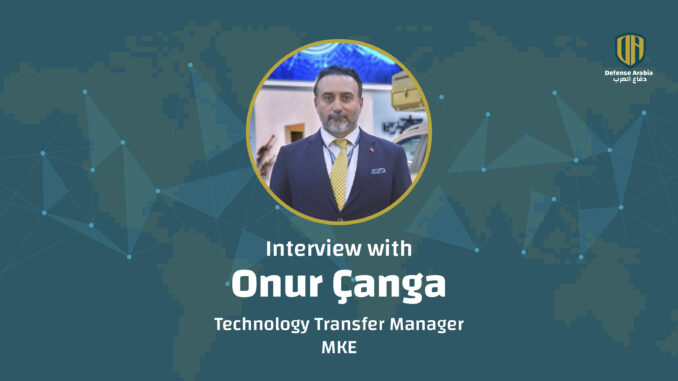
On the sidelines of SOFEX 2026, Defense Arabia spoke with Onur Çanga, Technology Transfer Manager at MKE, Turkey’s Mechanical and Chemical Industry Corporation. The conversation covered the status of the ammunition and aircraft bomb assembly lines in Jordan, the pilot batch production, and the prospects for Jordanian-Turkish defense cooperation over the next five years. Çanga also discussed MKE’s technology transfer projects in nine countries, its work in Saudi Arabia, and why larger projects naturally move more slowly.
What is the current status of the ammunition and bomb assembly lines in Jordan?
We have completed the integration of the systems. Dry runs and wet runs have been carried out, and we are now in the commissioning phase for the actual production of explosive material.
Has production started, and when will the first made-in-Jordan product be delivered to the Jordanian Army?
Production will begin as a pilot batch. Through it, we will demonstrate the full capabilities of the production lines, including medium-range munitions, long-range and large-scale heavy munitions, and the MK series aircraft bombs. We will produce all of them. Which one comes first depends on the army’s preference, and we will start with the one they choose.
Do you plan to export from Jordan to the GCC or other regional markets in MENA?
We are the integrator, and we do not operate the facility. The decision rests with the Jordanian Army. If they wish to export, or have plans to do so, they are free to do it. There is no limitation on them.
Beyond ammunition and bombs, and the products you already cooperate on, what else are the Jordanians interested in?
My focus is mainly technology transfer. We are discussing a few projects for the future, which I cannot disclose, and we are preparing a future partnership together with the Jordanian Army. We have collaborated with the Jordanian Army on technology transfer for more than a decade, and we intend to take that cooperation forward.
Are these projects related to air defense? Can you name the category?
It could be an air defense system, or it could be the army’s raw material requirements.
How do you see the collaboration between Jordan and Turkey, and MKE in particular, over the next five years?
I can confidently say that it will double or triple. There has been strong collaboration in the past, and we know each other very well. Our cultural roots are also very close. We fully understand each other’s requirements, demands and concerns, and that creates a high degree of compatibility between the two armies and the two defense industries.
What level of know-how do the Jordanians have, and can they manufacture everything that you produce?
I will start with MKE. MKE is 573 years old, and its roots go back to the conqueror of Istanbul. It was established by Sultan Mehmet the Conqueror as the Royal Artillery Foundation. We have been manufacturing cannons, weapons, propellants and equipment for hundreds of years. Over the last 100 years, with modern warfare, we have been manufacturing cartridges and munitions. Our propellant factory is 97 years old, and our cartridge factory is more than 100 years old. We have 11 factories, and by the end of this year we will put five more into service, bringing MKE to 16 factories. MKE was not established in one day. It was a long journey, and every small step leads to the next. We are planning the same approach for Jordan: step by step, with small achievements, we will build a major establishment for the defense industry.
You have done this in Egypt, and you are doing it in Jordan. What is the next country?
MKE is running 11 technology transfer projects across nine countries, not only Egypt or the Gulf region. From Southeast Asia to South America, projects are ongoing in nine countries. We are mostly collaborating with NATO and European countries, as well as on additional projects in the Gulf region.
How Is the cooperation with Saudi Arabia on Boran?
That cooperation is ongoing. We also have a facility development project with Saudi Arabia, and all the Gulf countries are within our scope. We are in contact with all of them, because Turkey is a loyal partner in developing future projects, and we always support the countries of the region. During the periods of conflict over the last year, we never stopped working in Jordan, and we never stopped working in KSA either. We do not hesitate to work on site and collaborate with our brothers and sisters. We will continue to develop the existing projects and to work with all countries in the region. It is hard to name just one, because all of them are in our scope.
There are reports that Saudi Arabia is not moving quickly in its collaboration with Turkey, and that Turkish companies have complained about obstacles. What is your view?
I have worked with Saudi Arabia personally since 2007 on different companies, joint ventures, technology transfer projects and facility establishments. As the scale gets larger, the process naturally slows down. I have worked with other foreign countries as well, and I believe this is natural. As Turkish companies, we will keep learning in order to deliver larger-scale projects. So it is hard to say there are obstacles, but as scales increase, obstacles do arise. That shows we are working on larger projects with Saudi Arabia, and that is why progress is slower.


Be the first to comment