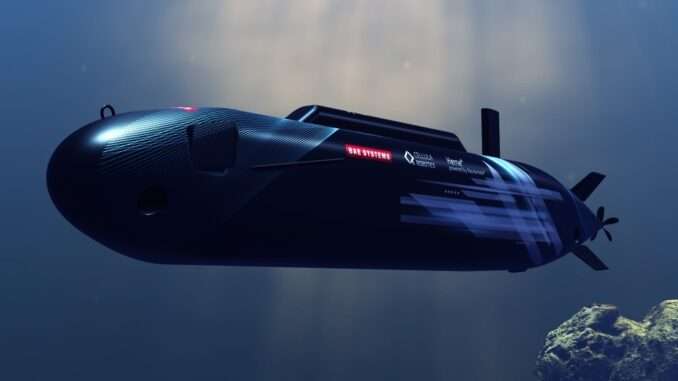
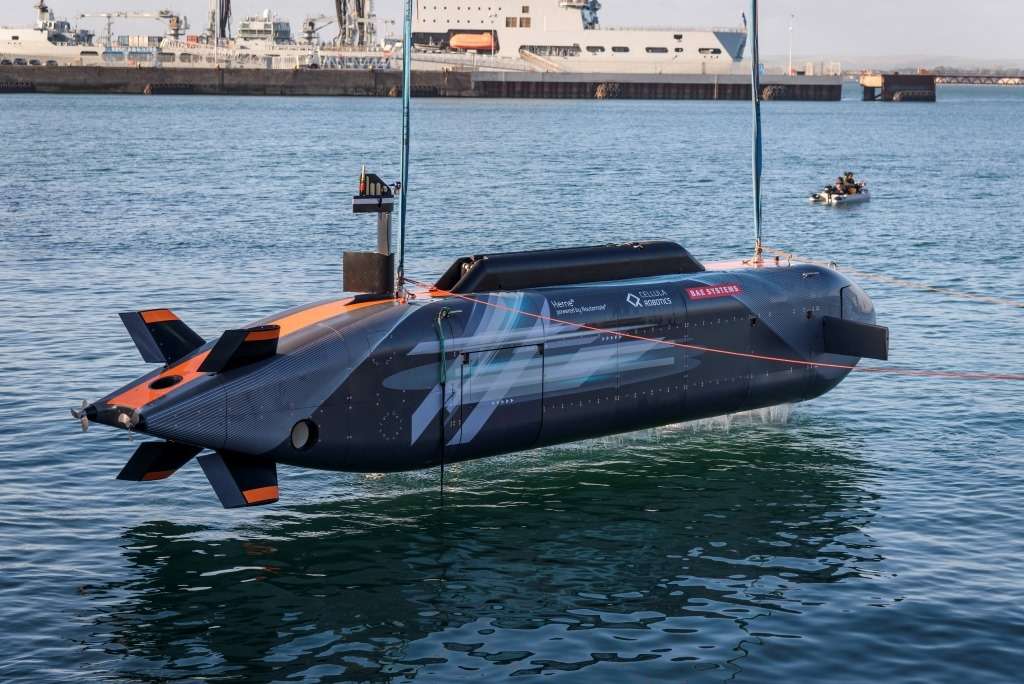
A team of British engineers based in Portsmouth has successfully demonstrated a new type of autonomous submarine, developed specifically for military use, off the south coast of England.
The vessel, called Herne, is what is known as an extra large autonomous underwater vehicle (XLAUV) and has been configured by BAE Systems to enable militaries to monitor and help protect underwater infrastructure across the vast expanses of the seabed, support anti-submarine warfare and provide another means for them to undertake covert surveillance missions.
The trials earlier this month saw the craft conduct a pre-programmed intelligence, surveillance and reconnaissance mission, powered by Nautomate, the Company’s platform agnostic high specification autonomous military control system. This follows successful trials of the technology on a surface vessel earlier this year.
Scott Jamieson, Managing Director of BAE Systems’ Maritime Services business, said: “Herne is a game changer in the underwater battlespace. It will give our customers a cost effective autonomous capability that will allow for a wide range of missions, end the reliance on crewed platforms, keeping people out of harm’s way and boosting endurance.”
Able to be fitted to existing or new build vessels, Nautomate gives users a cost effective option to boost their autonomous capabilities, allowing them to operate with greater scale, endurance and persistence, whilst removing the need for human crews to operate in arduous or dangerous conditions. This can free up skilled personnel to focus on the tasks where people add most value.
An added benefit of underwater autonomy is that, without the need to resupply or carry life support systems, Herne will be able to patrol the sub surface domain for far longer than a crewed alternative.
It can also be upgraded as new technology or ways of working evolve by using open architecture mission plug-ins.
BAE Systems collaborated with Canadian company Cellula Robotics to deliver the demonstrator configuration of Herne XLAUV. This successful collaboration resulted in a “whiteboard to water” capability in just 11 months, demonstrating the pace at which BAE Systems can deliver Herne and other autonomous maritime capabilities.
Now that the technology has been successfully demonstrated, the BAE Systems team will continue to refine Herne with further trials, depending on customer requirements.



Innovation: New Dual-Technology Internal Combustion Engine.
I have developed a new dual-technology internal combustion engine (diesel/gasoline) that combines the traditional crankshaft mechanism with a gear-based system, providing the engine with unprecedented efficiency and flexibility.
Technology Description;-
Stage (1 )
(at the top of the stroke): The piston operates with the traditional crank mechanism when it reaches the top dead center, ensuring a smooth start of movement.
Stage ( 2 )
(after leaving the top): The motion shifts to a gear-based system, where the reciprocating linear movement of the piston is converted into very high-speed rotational motion, achieving maximum work output according to the laws of physics.
Technical Advantages
1. Maximum work efficiency: Work vectors reach their peak values, while resistance vectors decrease to nearly zero.
2. Unlimited scalability: Any number of pistons and very large displacements can be added, depending on design requirements.
3. Extreme versatility: The technology allows engines to be designed for very high speeds (surpassing turbine engines) or low-speed operation depending on user needs.
4. Simplified mechanical structure: Piston rods connect directly to the main straight engine shaft without bearings, reducing weight and mechanical complexity.
5. Environmentally friendly: Thanks to its high efficiency, this engine approaches ideal performance, with lower fuel consumption and reduced emissions.
Potential Applications
Large commercial ships and aircraft carriers: due to the flexibility in controlling engine speed according to operational requirements.
Hydraulic systems: integrating this technology into rotary power transmission systems with high efficiency and adaptability.
Steam systems and renewable energy: the technology can enhance the conversion of steam piston motion into rotational power with greater efficiency, supporting power generation from solar heaters with better economic feasibility than solar panels in hot regions.
Aviation Innovations Report.
By Iraqi Inventor Falih Hassan Ahmed Al-Mansour
Member of the Iraqi Inventors Association.
I have developed several groundbreaking innovations in aviation and flying cars, supported by three patents, industrial prototypes, and new concepts that can transform the future of global air transportation.
———————–
1. flying cars, powered by internal combustion engines (diesel/gasoline) or solar energy.
——————-
Key Advantages:
1. Vertical take-off and landing without the need for airports.
2. Uses diesel/gasoline engines instead of turbine engines, with higher efficiency and lower fuel consumption.
3. Locally manufacturable using standard industrial materials (iron, L-angles, shafts, bearings) without advanced equipment.
4. Flexible design – blade length, width, and number can be customized for drones, helicopters, flying cars, or even giant aircraft.
5. Extended drone endurance – long flight hours possible due to reduced engine RPM, with solar energy or internal combustion support.
&&&&&&&&&&&&&&&&&
two. Internal Combustion Engines for Aircraft.
A new diesel/gasoline engine design tailored for helicopters, with higher RPM than turbine engines but lighter in weight
No crankshaft, allowing unlimited pistons and large displacements with very long strokes despite high rotation speed.
This innovation makes helicopters a practical, personal, and safe mode of transportation inside and outside cities.
&&&&&&&&&&&&&&&&
3. Additional Aviation Innovations
1. Emergency Landing Runway.
A system that allows aircraft to land safely without extending landing gear, reducing risks during system failures.
2. Flying Car Technologies
Combining the new propeller with advanced combustion engines enables the creation of safe and efficient flying cars.
The rotational wing-like blade design brings humanity closer to the ancient dream of flying like birds.
3. Solar-Powered Drones.
The propeller design allows drones to fly on solar power during the day and switch to diesel/gasoline engines when needed.
Capable of stationary hovering, enhancing applications in military, civilian, and research missions.
&&&&&&&&&&&&&&&&
Call for Collaboration
We invite aircraft and helicopter manufacturers, drone developers, and flying car companies worldwide to adopt these pioneering innovations.
These technologies can revolutionize global aviation and open new horizons for future transportation, including:
Personal aircraft.
Flying cars.
Long-endurance drones.
Giant vertical-lift aircraft.
———-+
These innovations can become a starting point for reshaping the future of air mobility worldwide.
Zzzzzzzzzzzzzzzzzzzzzzz