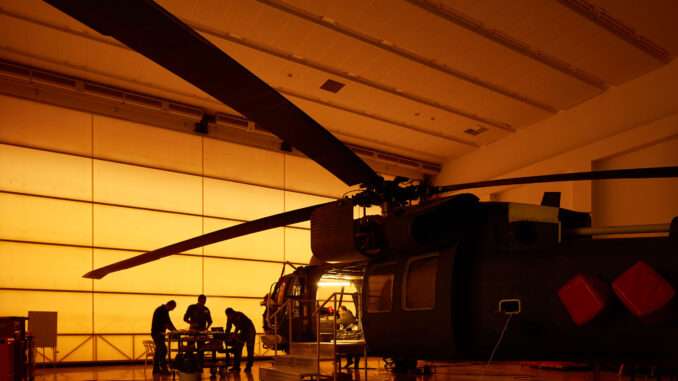
Aircraft modernization is assuming an increasingly significant role in military aviation as operators seek to enhance capability without awaiting full‑fleet replacement. For ASELSAN, this market is already well‑known. The company has executed more than 500 aircraft upgrades, integrating new avionics and mission equipment on fixed‑wing and rotary‑wing platforms from various manufacturers and generations.
The scope extends well beyond cockpit refurbishment. ASELSAN’s modernization covers mission computers, digital displays, navigation and communication systems, electro-optical sensors, weapon systems, nose radar and aircraft self-protection systems. The company can integrate these systems as a complete package or adapt the configuration to the customer’s existing equipment and operational requirements.
That capability to operate across diverse aircraft architectures is especially relevant for fleets that have accrued multiple generations of equipment over their service lives. Rather than mandating a uniform baseline configuration, ASELSAN can preserve appropriate legacy hardware and integrate new systems around it, thereby tailoring modernization to each individual platform.
A Digital Core for the Modernized Aircraft
A central element of ASELSAN’s avionics offering is ACORE Avionic Central Control Computer, which connects avionics, navigation, communication and identification functions within a common architecture. Its modular hardware and scalable software allow existing equipment and newly introduced systems to operate together, while leaving scope for later additions.
In the cockpit, ASELSAN combines mission computers with multifunction displays to bring flight, navigation and mission information into a more integrated presentation. This is intended to reduce the number of separate interfaces the crew has to manage and provide quicker access to information from onboard systems.
ASELSAN’s AVCI Helmet-Mounted Display adds another layer for combat and rotary-wing applications. Flight, navigation and targeting information can be projected into the pilot’s field of view together with night-vision and infrared imagery. The system also supports line-of-sight cueing, allowing the pilot to interact more directly with the aircraft’s sensors and targeting functions.
Navigation and Communications for Contested Operations
ASELSAN’s modernization portfolio also addresses two areas that have become increasingly important in today’s air operations: resilient navigation and secure connectivity. KILAVUZ Tactical Inertial Measurement Unit and ANS-600 Inertial Navigation System help aircraft maintain accurate position and attitude information when satellite navigation is degraded or unavailable. Complementing these capabilities, ATRAS, ASELSAN’s Traffic and Terrain Collision Avoidance System, enhances situational awareness by providing traffic and terrain information to support safer flight operations. ASELSAN’s navigation portfolio also includes ARVEN, a compact radio navigation system that integrates various functions into a single unit, simplifying avionics architecture while providing multiple navigation capabilities in one solution.
For communications, ARTcom family of software-defined airborne radios provides secure voice and data links with NATO-compatible waveforms and electronic protection measures. these radios allow aircraft originally designed around older communication concepts to operate more effectively within current mission networks and exchange information with other airborne and ground elements.
Sensors and Self-Protection
Electro-optical systems can also be incorporated as part of the modernization package. ASELFLIR family, provides day-and-night detection, tracking and targeting capability. Rather than operating as an isolated payload, the sensor can be linked with the aircraft’s mission computer, navigation and cockpit displays, giving the crew direct access to sensor information during the mission.
Survivability constitutes a further pivotal aspect of ASELSAN’s avionics integration portfolio. The company offers electronic warfare and self-protection systems against radar, laser and infrared threats, allowing older aircraft to receive defensive capabilities developed for today’s threat environment.
Among these capabilities is YILDIRIM-100, a Directed Infrared Countermeasure (DIRCM) system that uses laser-based technology to protect aircraft against heat-seeking missiles. Designed to work alongside other warning and countermeasure systems, it can be integrated into a broader aircraft self-protection suite, enhancing survivability against infrared-guided threats.
For fighter aircraft, ASELSAN’s MURAD Nose AESA Radar provides high-resolution, forward-looking situational awareness through a compact active electronically scanned array architecture. Its multi-mode detection and tracking capabilities give modernized platforms enhanced situational awareness and mission effectiveness without requiring a complete replacement of the aircraft.
Minimizing Ground Time for Aircraft Integration
For operators, the capabilities provided by a modernization package represent only a portion of the overall equation. The duration required for integration and testing is equally critical, especially for fleets that must sustain high availability.
ASELSAN uses System Integration Laboratories (SILs) to develop and test avionics configurations before carrying out system on the aircraft itself. These laboratories reproduce key parts of the aircraft environment, allowing engineers to test interfaces, software and system behavior on the ground. This reduces the amount of development activity that needs to be performed on the operational aircraft and can shorten the period it remains out of service.
ASELSAN supports the full integration cycle, including ground and flight testing, qualification and certification. Modernization activities can be conducted at ASELSAN’s facilities in Türkiye or at customer sites through deployed technical teams.
The same infrastructure can remain useful after delivery. SILs can support training and later software development, while ASELSAN can transfer maintenance, calibration and repair capabilities to the customer depending on program requirements. This gives operators greater control over sustainment and future upgrades rather than tying the aircraft permanently to the original modernization facility.
A Growing Role for Avionics Modernization
For air forces operating mixed fleets, the modernization question is increasingly about where investment can deliver the largest operational return. Aircraft with remaining structural life can still gain substantially from new mission systems, particularly when upgrades improve several areas at once rather than replacing individual pieces of equipment.
ASELSAN’s more than 500 aircraft upgrades give the company a substantial base of integration experience across different platform types. Its portfolio also allows many of the key elements of an upgrade, from the cockpit and mission computer to communications, electro-optics, navigation and self-protection, to be sourced and integrated within the same modernization program.


Be the first to comment