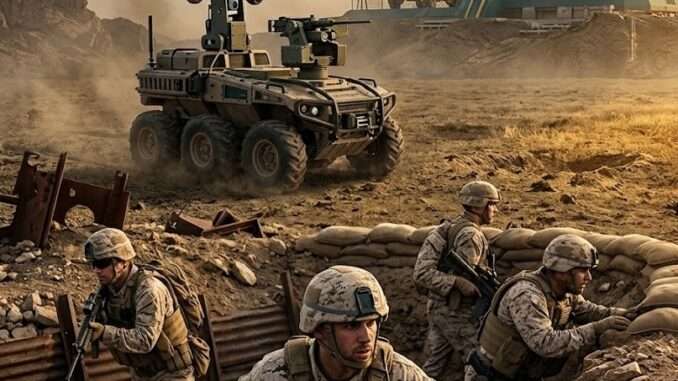
At first glance, this video below could easily be mistaken for a battlefield from the First World War. But we are in the second quarter of the 21st Century.
Open terrain. Soldiers exposed to enemy fire. Men moving from one position to another, seeking whatever cover the ground can offer.
More than a century has passed, yet some realities of warfare remain remarkably familiar.
What has changed dramatically is the technology surrounding the soldier. Today’s battlefield is filled with drones, thermal imaging, precision weapons, advanced communications, electronic warfare and increasingly autonomous systems. Weapons have become more accurate, more connected—and far more lethal.
And yet, when soldiers are forced to fight across open ground, the fundamental problem looks disturbingly similar to what soldiers faced in the early 20th century:
The human being is still exposed.
Technology has transformed warfare, but it has not eliminated one of its oldest vulnerabilities.
Perhaps this is one of the most important lessons of modern conflicts: the future of warfare cannot simply be about developing more powerful weapons. It must also be about removing soldiers from unnecessary exposure through unmanned systems, remote weapon stations, robotics, sensors and greater stand-off capability.
The battlefield may sometimes look like 1916.
But the technology protecting the soldier should belong to the future.


Be the first to comment