
Patricia Marins
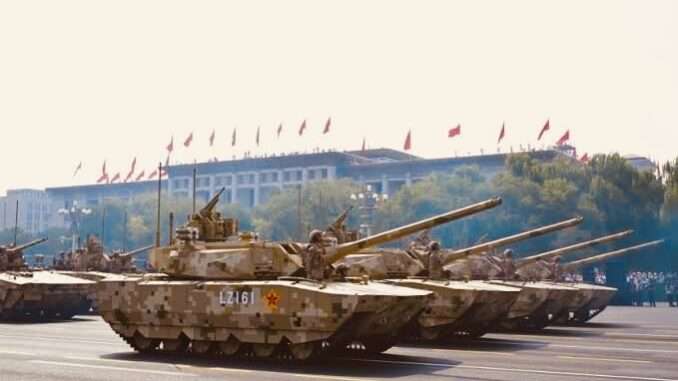
In September 2025, during the Victory Day parade in Beijing, China unveiled the Type 100 family (or ZTZ-100), a suite of vehicles representing a revolution in how the PLA conceives land combat. Inspired by lessons from the Ukraine war – where heavy tanks became easy targets for cheap FPV drones – the Type 100 refines the doctrine of intelligent, unmanned warfare. Instead of prioritizing frontal assaults with heavy armor, the focus shifts to lightweight, connected systems operating in a wolfpack formation, with real-time decisions made by AI.
Traditionally, tanks have been platforms of brute firepower. The Chinese concept sees the Type 100 as an integrated combat ecosystem: a digital network where vehicles, drones, helicopters, and artillery operate in sync, in sensor-rich formations designed to detect and engage the enemy before they even notice. Other advantage is the silent operation of hybrid diesel-electric propulsion, ideal for stealthy ambushes.
It’s the behavior of a high-tech wolfpack, with 360° sensors (optical, infrared, and AESA radar), GL-6 active protection systems, and laser dazzlers against drones and missiles.
Each vehicle carries multi-rotor drones for reconnaissance and UGVs for mine clearing or ambush operations. Kamikaze drones are launched from support vehicles equipped with VLS for precise beyond-line-of-sight attacks, not to mention integration with guided missile launch units operating several kilometers behind the front lines. In other words, a mini Aegis on land, focusing on collective intelligence to amplify firepower.
The Type 100 formation comprises four main vehicles: LZ161, LZ174, LZ183, and LZ153. Command and control are distributed via AI networks, with no fixed command vehicle, allowing harmonious operation in a mixed assault formation.
LZ161 (Light Tank) – acts as the spearhead, positioned at the forefront to breach defenses with guided munitions, including AtGMs, acquiring targets via drones and 360° sensors—perfect for rapid penetration.
LZ174 (IFV) operates on the flanks. This IFV carries 3-4 soldiers and is a key component of hybrid operations. Armed with a 30mm autocannon, a 3×2 VLS for loitering munitions, AESA anti-UAV radar, and electronic jamming, its goal is to create an air denial zone.
LZ183 (MBT) is at the heart of the formation, leading direct engagements against heavy armored targets. With a 125mm gun, versatile ammunition, and AR 360° situational awareness, it operates within the network, including BVLOS strikes.
LZ153 (Recon and Support) at the rear focuses on intelligence and logistical support, controlling UGVs for terrain reconnaissance (detecting mines via acoustic and seismic sensors) and drones for surveillance. Equipped with laser dazzlers and other countermeasures, it ensures collective survivability.
This formation integrating IFVs like the LZ174 and LZ153, aligning with my concept of fast motorized infantry advancing alongside tanks.
In summary, the Type 100 demonstrates that the Chinese are absorbing lessons from Ukraine -swarm drones, rapid assaults, mines – and responding with a system that prioritizes survivability and precision. We are witnessing an exceptional development that challenges Russian and Western tank doctrines.
The Chinese formation can easily operate with motorcycle units and 4×4 vehicles using AR glasses at the front, improved formations as already used in the Ukraine war. But not only that, it can also be adapted to operate in swarms of drones and other weapons guided by motorcycles.
This integrated, cohesive, small, and self-sustaining formation embodies the Chinese revolutionary concept.
In my view, despite its innovation, this model could become a mini BTG if it fails to effectively counter drone threats. The lessons from Ukraine go beyond integration, but this concept signals a trend in Chinese land, air, and sea forces: integration and AI.




Be the first to comment