
Patricia Marins
The Chinese air-to-air missile with a range of 800-1000 km represents the beginning of a new concept in aerial warfare.
Recently, Chinese scientists announced the final tests of a new hypersonic missile, with a range of 800-1000 km, which is an air-to-air missile with an unprecedented range.
According to Chinese publications, heat-resistance testing has been conducted within an extreme Mars mission tunnel, testing its resistance under high friction and extreme temperatures.
Currently, the Chinese are developing long-range air-to-air missiles like the PL-17 and PL-21, which have a range of approximately 350 to 400 kilometers.
It seems that the Chinese missile will be a game-changer, not only due to its range—twice that of the Russian KS-172/K-100/R-37M missiles, which have ranges of up to 200-400 km—but also because it has a range four to five times greater than Western missiles.
This raises an important question: Why does China need a missile with such a range when the detection capability of the most advanced fighter aircraft radars is limited to 150-400 km, and even less for identification and targeting? This question is crucial, and I will attempt to address it further in the text.
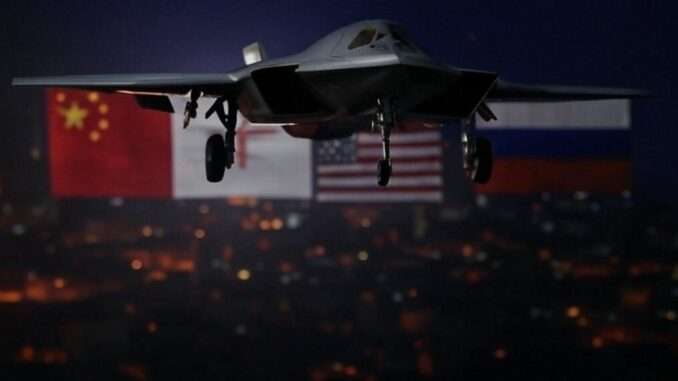
Not long ago, the Chinese announced a series of advanced drones, some of which are stealthy and capable of high-altitude flights. These drones can conduct continuous reconnaissance and surveillance over areas of hundreds of thousands of square kilometers at a time, performing wide-area searches for theater-level units. The WZ-8 is referred to as one of these “strategic-level drones.”
Information from the manufacturer indicates that these drones can operate at altitudes of up to 48 km, which leads me to suspect that they can perform target acquisition for the new Chinese missiles with a range of 800-1000 km.
Given the capabilities of Chinese technology, these drones can accomplish this via data links within an integrated surveillance and control system at high altitudes, gaining advantages from a longer angular radius and operating kilometers above their targets. This poses a significant challenge for adversaries. Not long ago, the US had to deploy its F-22—which is no longer in production—to shoot down a Chinese balloon flying at around 60,000 feet, which is half the altitude at which Chinese strategic drones can operate.
The current generation of Chinese radars is entirely compatible with the assertion I’m making.
The latest systems in China for its air force and navy utilize GaN MMIC technology, whereas most systems in the US still use GaA.
In early 2008, China achieved a 119W GaN TR Module, and while the F-35 is transitioning to GaN with its APG-85 radar, China has made significant breakthroughs with GaO MMIC, at least one gen ahead.
What I mean to emphasize is that while many countries are integrating AWACS with ground and air systems, the Chinese appear to be developing a very high-speed network that connects aircraft and drones. This system enables them to deploy missiles with ranges of 800-1000 km and precisely locate enemy positions while targets are flying 20 to 40 km under them.
This represents a complete rethinking of current capabilities, effectively placing both Russians and Westerners in a difficult position.
The speed at which China is currently advancing its military technology is likely to create a significant gap between them and the rest of the world in less than two decades.




Be the first to comment