Syed Ali Abbas
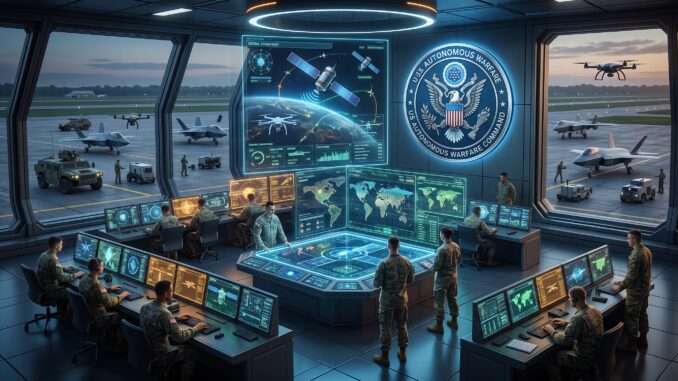
On 30 September 2026, US Defense Secretary Pete Hegseth announced plans for an Autonomous Warfare Command, or AutoWarCom. The four-star combatant command, with service-like acquisition authorities, would build and supply robotic and autonomous capabilities across the joint force. The Pentagon’s memo targets October 2027, subject to congressional approval.
The budget shows the scale. The Pentagon’s budget documents seek up to $54.6bn for autonomous warfare in fiscal year 2027, up from $226m this year for the DefenseAutonomous Warfare Group, a roughly 240-fold increase. Hegseth also said the departments are phasing in new specialties and career paths for “autonomous warfighters”. A command, a budget line and a career path together show how the US military is institutionalising autonomy.
AutoWarCom points to where warfare is heading. Other militaries are adopting autonomy by different routes, and the wars in Ukraine and Iran show what it looks like in practice: cheap systems in large numbers, with software handling more of the sensing, targeting and navigation. In such a war, advantage depends as much on software, edge computing and data pipelines as on hardware. Great-power rivalry is speeding this up, but the systems already in use show how future wars may be fought.
Patterns in both wars
Across both wars, autonomy is entering combat through four channels at once.
Strike is the most visible. Iran’s Shahed drones navigate by inertial and satellite guidance, and later variants reportedly add seekers for the final kilometres. Washington answered with LUCAS, a copy of the Shahed at about $35,000 a unit, first used in combat on 28 February. In Ukraine, guidance modules let a drone finish its attack after jamming cuts the control link. CSIS concludes that Russia has likely fielded a fully autonomous drone, the V2U, against targets in Ukraine.
Defence has to answer at the same cost. Estimates state that a Shahed costs $20,000 to $50,000, while a Patriot PAC-3 MSE interceptor costs about $4.1m. Both wars have produced cheaper solutions. Ukraine flies interceptor drones against one-way attack aircraft, and the US Army has reportedly bought 13,000 Merops interceptors at about $15,000 each to reduce interception cost.
Machines now go where soldiers cannot survive. Drones made the zone near the front a kill zone, and Ukrainian ground robots followed. The defence ministry counts about 112,000 logistics and evacuation missions between January and early September, a monthly figure that rose from 7,511 in January to 25,143 in August. Russia sends Kurier robots on similar work. At sea, CENTCOM said it struck the Bandar Abbas naval base on 12 July with one-way attack surface drones, and Ukraine’s Magura and Sea Baby boats have pushed Russian ships back in the Black Sea.
Targeting is changing as well. Commentary on the Iran war reports that Palantir’s Maven Smart System helped CENTCOM strike 1,000 targets in the first 24 hours. Here software shapes the decision before any weapon is launched.
Though, autonomy is still in development. A July 2026 brief by the EPIK think tank finds that systems labelled autonomous mostly follow pre-set routes and that genuine autonomy remains “largely aspirational”. The current trend nonetheless suggests that a war fought with such systems will reward whoever can replace and update them fastest.
What the software must do
Three technical layers sit under these examples. Edge computing puts recognition and navigation on the platform itself. CSIS says recovered Russian V2U drones carried onboard processing but no components for operator control. Mesh networking lets uncrewed systems share tasks when links to headquarters fail, and the same study reports that V2U drones coordinate in groups. Retraining pipelines adapt models to an opponent’s new tactics and push updated code to the force. Ukraine’s ministry already logs ground-robot missions in its DELTA battlefield system, the kind of data such pipelines depend on. The side that completes that cycle faster holds an advantage that compounds.
Control at machine speed
As decision cycles shrink and jamming cuts links to operators, systems must act on authority granted in advance. The wars already show how differently that authority can be arranged. Ukraine’s naval drones navigate and target partly on their own, yet a human operator still decides when to detonate. Russia’s V2U, by CSIS’s account, appears to have no operator link at all. In targeting, a pace of 1,000 strikes in 24 hours, as commentary reports for the opening of the Iran war, leaves little time to examine each one. Department of Defense Directive 3000.09 requires “appropriate levels of human judgment over the use of force”, but it sets no measurable standard for what that means. The real question is where the human sits: approving each strike, setting parameters before launch, or reviewing outcomes afterwards.
Software also resists verification. Arms control has depended on assets that can be counted, such as silos, hulls and warheads. A state cannot easily judge the quality of an adversary’s targeting software or the speed of its update cycle, so each side may misread the other’s strength. To be sure, the case for speed has merit. Rivals are investing, and a state that holds back may lose the initiative. Autonomy can also reduce risk to soldiers and, if well designed, to civilians. None of these settles how much authority machines should hold, or who answers when they err.
AutoWarCom cannot settle how future wars will be fought, but it shows what governments expect: cheap systems in large numbers and software that changes faster than hardware, with humans at the edges of each decision instead of the centre. The fighting in Ukraine and Iran supports that expectation. The test now is whether states define human control in terms that can be measured, such as review time, the information an operator sees and the authority to override, before the institutions built around autonomy make a looser standard permanent.
Op-ed | US AutoWarCom and the Future of Warfare


Be the first to comment