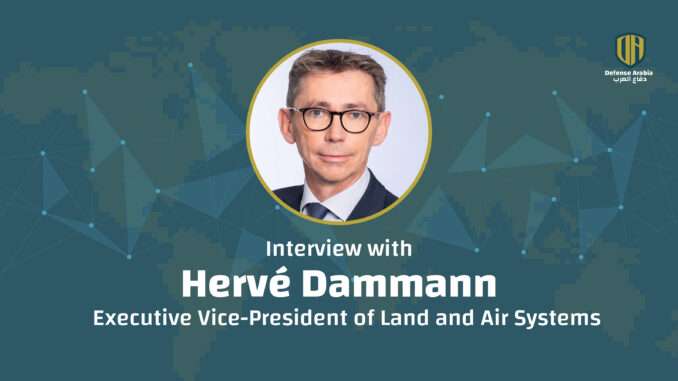
As high-intensity conflict, hybrid warfare, and proliferating drone threats redefine the modern battlefield, resilience and decision superiority have become decisive advantages. At World Defense Show, Defense Arabia sits down with Hervé Dammann, Executive Vice-President of Land and Air Systems at Thales, to discuss how the company is integrating AI, sensor fusion, and modular air defence architectures to deliver faster, smarter, and sovereign-ready solutions for today’s armed forces—particularly in the Middle East.
1. How does Thales’ Land and Air Systems strategy align with the evolving threats we’re seeing today, especially in high-intensity and hybrid warfare?
In today’s complex threat environment, our Land and Air Systems strategy addresses the full decision chain: from threat detection to analysis and neutralisation.
The key is resilience and adaptability. Our unique solutions and systems allow forces to integrate new capabilities as threats evolve, particularly in counter-UAS and multi-domain operations, while continuing to operate in contested environments.
We achieve this by combining advanced sensors into high end systems performing superior data fusion, thanks to AI introduction to help commanders transform complexity into clear, actionable insight. Our objective is simple: ensure armed forces can make the right decisions at the right time, maintaining operational superiority across land and air domains.
2. How do you balance innovation speed with reliability when delivering systems to armed forces?
Innovation in defence only has value if it’s trusted and operationally proven. The balance comes from how we introduce new capabilities.
Our Integrated Air and Missile Defence solutions allow us to upgrade systems incrementally, adding, for instance AI-driven threat classification or enhanced sensor fusion without replacing entire platforms. This means armed forces benefit from cutting-edge capabilities while maintaining the reliability of proven systems.
Equally important is working directly with operators throughout development. Their feedback ensures innovations solve real operational challenges, not theoretical ones. Speed matters, but only if what we deliver actually works when it counts.
First of all, as threats evolve, Thales remains focused on delivering future-ready solutions that provide resilience, adaptability, and long-term operational value.
Balancing innovation speed with reliability starts with an incremental, modular approach. Our Air and Missile Defence Solution is built on a proven architecture that lets us add new capabilities like AI-driven threat classification or enhanced sensor fusion through software or hardware plugins rather than wholesale platform replacement.
By working hand‑in‑hand with operators throughout development, we ensure each upgrade solves a real operational need and is tested in the exact environment where it will be used, so speed never comes at the expense of performance.
3. Digitalisation and AI are reshaping defence, how is Thales integrating these technologies into land and air platforms in practical terms?
In practical terms, AI is transforming how our systems handle the speed and complexity of modern threats. Through cortAIx, Thales’s AI accelerator,the Group has been working for many years on integrating AI into critical systems.
Take our Ground Master radars for example. The inbuilt AI system helps classify threats in seconds rather than minutes, filtering false alarms so operators can focus on genuine threats. Likewise, in counter-UAS operations, AI enables a single operator to manage autonomous drone swarms that would previously require multiple teams.
But technology alone isn’t the answer. We apply our TrUE AI framework across these capabilities to ensure transparency, reliability, and ethical use. This means operators understand how the system reaches its conclusions and remain in control of critical decisions – AI proposes, commanders decide.
The result is systems that detect and neutralise threats faster while reducing cognitive burden on operators, which is essential in high-intensity, multi-domain operations.
4. How important is sensor fusion today, and how is Thales helping commanders make faster, better decisions?
Sensor fusion is the cornerstone of modern airspace protection and defence where commander must interpret vast volumes of information from multiple sensors. It combines multiple sensor views into a single, more accurate and reliable picture of the environment, reducing uncertainty and blind spots.
Thales enables faster, better decisions by delivering an end‑to‑end fusion ecosystem that brings together heterogeneous sensors on an open, standards‑based architecture and enriches the data with AI‑driven analytics. Our radars feed high‑resolution detections into a common data bus where advanced digital signal processing and machine‑learning classifiers automatically correlate tracks, de‑conflict duplicates and assign confidence levels.
Thales is laying the foundations for fully collaborative radars where sensors are networked so they share data in real time, delivering a single and richer air picture rather than many isolated views. This collaborative approach will improve detection and tracking of threats and targets and provide commanders with common air picture for timely and coordinated action.
5. How does Thales tailor its land and air solutions to the operational needs of Middle Eastern armed forces?
We tailor our solutions by understanding each country’s specific threat environment and defence priorities, and then aligning our solutions accordingly.
In Saudi Arabia we’re looking to support our clients in addressing an increasingly complex threat landscape that requires both immediate operational capability and long-term sovereign capacity. Our focus is on delivering AI-driven air defence and surveillance solutions while working with our partners in the Kingdom to build in-country capabilities through technology transfer, local manufacturing, and skills development aligned with Vision 2030.
At the core of our offer is sovereignty. We’re looking at supporting nations build capabilities they can own, sustain, and evolve independently over time – building a future we can all trust.
6. What role does local industry and technology transfer play in Thales’ long-term vision for Saudi Arabia?
Local industry and technology transfer are foundational to our long-term vision in Saudi Arabia. They’re how we support our clients in building sovereign capabilities that can be owned, sustained, and evolved by Saudi talent.
Our commitment to the Kingdom spans over 50 years, and we’ve reinforced this through concrete partnerships like SAMI Thales Electronic Systems (STES), which is our joint venture with Saudi Arabian Military Industries, working under Vision 2030’s directives. We’re looking to work with national stakeholders to progress along the value chain – from local assembly and support to joint development and knowledge creation through structured technology transfer programmes.
Human capital is a central pillar to this strategy. Beyond our Early Careers Programme, we’ve developed initiatives like the Saudi Academy of Civil Aviation, where students receive training in Thales-related fields. The objective is equipping Saudi engineers and technicians with the expertise needed to manage complex defence systems throughout their lifecycle.
Our goal in the Kingdom is clear: support our clients in the Kingdom in achieving Vision 2030, by enabling sovereign industrial capacity that’s built to last.
7. From your perspective, what feedback do you hear most often from operators using Thales land or air systems in the field?
Some of our solutions are combat proven and this allows us to get direct feedback from users. We are learning a lot to adjust and develop solutions according to this feedback.


Be the first to comment