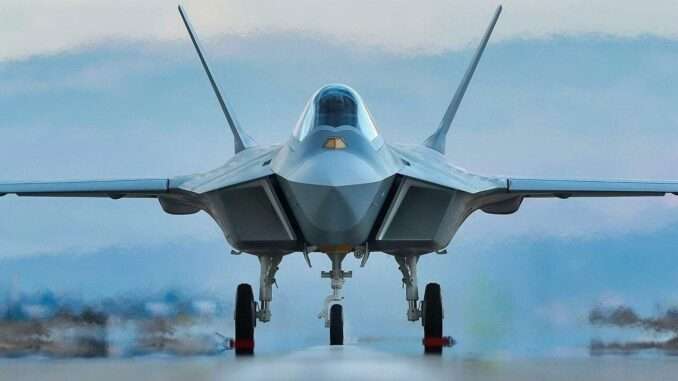
Turkish Aerospace Industries (TAI/TUSAŞ) has announced that it conducted taxi tests (ground movement) on the second prototype of its fifth-generation stealth fighter “KAAN,” known by the designation P1, after the aircraft moved under its own power on the runway for the first time, a new step bringing the Turkish program closer to the developed prototype’s first flight.
According to sources following the program, low-speed taxi trials for the P1 prototype were carried out in late July 2026. This timing represents an actual delay compared to the schedule previously circulated by industry sources, which had targeted P1’s first takeoff sometime between April and June 2026, before supply chain and manufacturing factors pushed it back. While taxi tests are considered a routine step in aircraft development programs, their importance lies in the fact that this is the stage during which integration between propulsion, braking, steering, and flight control systems is verified, before the aircraft undergoes actual flight loads for the first time.
Speaking on the sidelines of the Farnborough International Airshow 2026, TAI CEO Mehmet Demiroğlu avoided setting a precise date for P1’s takeoff, saying only that the aircraft “may fly within the coming few months,” and explaining that the company is awaiting completion of a number of ground tests and flight systems before proceeding. He added that the goal is for the third prototype, P2, to also fly before the end of 2026, which would allow two KAAN aircraft to operate side by side by year’s end, though by Demiroğlu’s own phrasing this remains a stated ambition rather than a firm commitment, especially given that P1 itself has already been delayed more than once. As for the timing of the first delivery of production-standard KAAN aircraft to the Turkish Air Force, Demiroğlu affirmed that it remains set for 2028, while acknowledging that advanced fighter development programs inherently involve challenges that could later affect this timeline.
The P1 prototype features a more mature design than its predecessor, P0, which first flew on February 21, 2024, in a flight lasting around 13 minutes. P1 incorporates structural modifications including a reduction in fuselage length of about one meter compared to P0, along with a widened center fuselage section and a redesigned nose to increase internal space for systems, as well as new “ramp”-type air intakes fitted with S-shaped internal ducts to support supersonic performance and reduce radar signature. P1 is the first prototype fully equipped with most of the combat systems planned for the operational version, making it effectively the bridge between the first experimental prototype and the full combat-ready aircraft.
The prototypes currently run on two US-made General Electric F110 engines, while Turkey pursues a parallel track to develop an alternative indigenous engine named TF35000, which is set to be adopted in later stages of the program. Demiroğlu confirmed that US authorization to export F110 engines intended for serial production of KAAN aircraft was approved by the US Congress on July 9, 2026, and that the company currently holds ten engines of this type in Ankara to support the prototype and testing phases, in addition to working to acquire 80 additional engines to support the first phase of serial production.
The KAAN program, launched in 2016 under the name “National Combat Aircraft” following Turkey’s exclusion from the US F-35 program, is part of Ankara’s drive to build sovereign capability to manufacture a fifth-generation stealth fighter that will gradually replace the F-16 fleet operated by the Turkish Air Force, alongside opening broad export prospects. Indonesia has already secured, during the IDEF 2025 exhibition, a strategic agreement to acquire 48 KAAN fighters over a ten-year period.


Be the first to comment