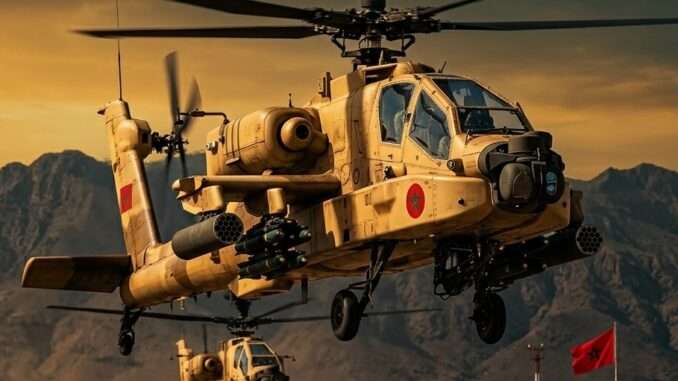
Morocco’s Royal Air Force has taken delivery of its second batch of Boeing AH-64E Apache Guardian attack helicopters, marking a significant milestone in the Kingdom’s accelerating drive to modernize its offensive air capabilities and enhance operational readiness across its armed forces.
Defense analysts tracking the delivery have identified the new aircraft by serial numbers beginning at 2407 and running through to 2412, with some intermediate numbers omitted — a sequencing pattern consistent with phased delivery schedules under a structured government-to-government acquisition program.
The latest batch follows Morocco’s acceptance of its first tranche of six AH-64E Apaches in March 2025, a ceremony attended by a distinguished bilateral delegation including Abdellatif Loudiyi, Morocco’s Delegate Minister for National Defense Administration; General Mohammed Berrid, Inspector General of the Royal Armed Forces; General Michael Langley, Commander of United States Africa Command (AFRICOM); and Amy Cotrone, Chargé d’Affaires at the U.S. Embassy in Rabat.
A statement issued by the Royal Armed Forces noted that the delivery was conducted “in accordance with Royal directives aimed at modernizing the Armed Forces and strengthening their defensive capabilities,” affirming that the transaction reflects the depth of the strategic defense partnership between the Kingdom of Morocco and the United States.
The deliveries are the product of a June 2020 government-to-government agreement with the U.S. Department of Defense for the acquisition of 24 AH-64E Apache Guardian helicopters — a centerpiece of Morocco’s broader, multibillion-dollar effort to equip its military with advanced weapons systems across all branches of service.
Combat Capabilities: A Fully Integrated Strike System
The AH-64E Apache Guardian ranks among the most capable attack helicopters in active service worldwide, combining formidable firepower with advanced electronic systems. The aircraft is armed with a 30mm M230 chain gun mounted beneath its nose, capable of engaging ground targets with high-explosive ammunition at short-to-medium ranges with high precision. Its primary anti-armor weapon is the AGM-114 Hellfire laser-guided missile, with a range of approximately eight kilometers, enabling standoff engagements against tanks and fortified positions from beyond the reach of most ground-based air defense systems.
The platform can additionally carry Hydra 70 unguided rockets alongside a variety of guided and unguided munitions, significantly expanding its tactical options across diverse battlefield scenarios and threat environments.
Longbow Radar: The System’s Strategic Edge
What sets the AH-64E variant apart is its integration of the AN/APG-78 Longbow Fire Control Radar — a millimeter-wave system capable of detecting, classifying, and tracking ground and aerial targets at extended ranges in adverse weather conditions and complex terrain. The radar enables simultaneous tracking of multiple targets and real-time cueing of Hellfire missiles with exceptional precision, conferring a clear tactical advantage in modern, high-intensity combat environments.
The fusion of the Longbow radar with the aircraft’s electro-optical and electronic sensor suite enables coordinated mission planning and real-time communication with ground and air units, transforming the Apache Guardian into a fully integrated multi-role strike and reconnaissance platform capable of sustained operations around the clock and under severely limited visibility conditions.
With the addition of this second batch, the Royal Air Force of Morocco gains a meaningful uplift in close air support and offensive strike capability. As the Kingdom progresses toward completing its full fleet of 24 aircraft, the AH-64E acquisition is set to deliver one of North Africa’s most capable rotary-wing attack forces — reinforcing Morocco’s defense posture and its capacity to respond to the evolving and complex security dynamics of its regional environment.


Be the first to comment