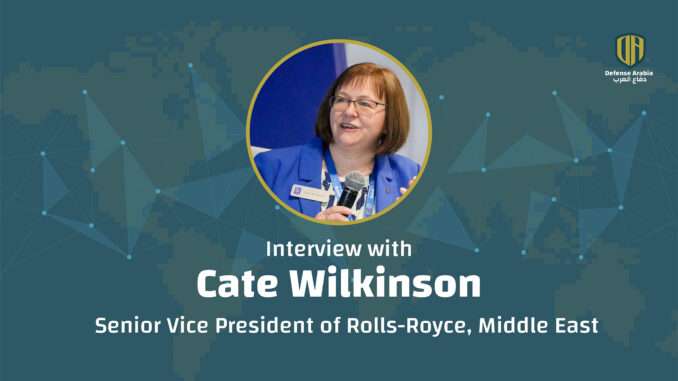
As Saudi Arabia accelerates the localization of its defense and aerospace capabilities under Vision 2030, global industry leaders are playing an increasingly pivotal role in building in-Kingdom expertise. Rolls-Royce, a long-standing partner of the Kingdom, stands at the forefront of this transformation through its Taif Maintenance, Repair and Overhaul (MRO) facility, which supports the Royal Saudi Air Force’s Eurofighter Typhoon fleet while developing Saudi technical talent. In this Q&A, Cate Wilkinson, Senior Vice President of Rolls-Royce Middle East, discusses the strategic importance of the Taif MRO, workforce localization, women’s participation in aerospace, and the future skills shaping Saudi Arabia’s aviation sector.
Why is the Taif MRO facility strategically important for Rolls-Royce and for Saudi Arabia’s aviation sector?
Rolls-Royce’s partnership with Saudi Arabia dates back to the 1960s as the Kingdom laid the foundations of its modern defence and aerospace sectors. The Taif Maintenance, Repair and Overhaul (MRO) facility is strategically vital because it serves as a frontline Service Delivery Centre for the RSAF.
The facility is closely linked to the primary hub for the RSAF’s Eurofighter Typhoon fleet. This allows MRO support for the EJ200 engines that power Typhoon, helping to ensure the fleet remains mission-ready.
The Taif MRO facility also supports the Kingdom’s Vision 2030, as a significant and growing number of the technical employees are Saudi nationals. This means a growing, localised skill-set is developing, with engine maintenance available in-Kingdom.
Furthermore, it also acts as a feeder into the broader Saudi aerospace network. We work with our partner Middle East Propulsion Company (MEPC) to create a seamless domestic end-to-end MRO pipeline.
How has increasing the participation of Saudi women changed the working environment and performance at the Taif MRO?
We are committed to creating opportunities for Saudis across our entire business in the Kingdom and proud to confirm that Saudi nationals now make up over 80 per cent of our workforce, of which more than 10 per cent are women.
Rolls-Royce has benefitted from an increasing pool of motivated and talented resources – with a larger local talent pool, technical roles are filled quicker, directly improving engine availability for the Typhoon fleet. Our facility has turned into a high-status employer, a progressive, merit-based environment that attracts talent from Saudi universities, encouraging even more careers in STEM.
It has proven to be a performance multiplier that ensures we are aligning with the key pillars of the Kingdom’s Vision 2030, by creating career opportunities that foster skills that are both sustainable and transferrable, therefore truly contributing towards long-term economic diversification.
How has developing Saudi human talent helped Rolls-Royce build a strong and sustainable business in the Kingdom?
We have moved from being an international vendor to a local industrial partner, contributing to the Kingdom’s Strategic Autonomy for decades to come. By upskilling the local workforce in technical and leadership roles, we are ensuring long-term capability and self-sufficiency.
Rolls-Royce has created a localised technical base with the Taif MRO facility that can respond to the RSAF needs in real-time. Our continued investment in local talent ensures our business is woven into the fabric of the Kingdom’s economy, rather than being an external service provider.
What role do training and partnerships play in preparing Saudi engineers and technicians for advanced MRO operations?
With hundreds of engines in service for RSAF, the on-the-job training provided to engineers at the Taif MRO facility, and even opportunities for exposure to our facilities across the globe, is creating a highly trained Saudi workforce.
Training and partnerships create a collaborative but specialised network, ensuring Saudi engineers and technicians can support both the frontline support, while the domestic partners, such as MEPC, support an industrial backbone.
Looking ahead, what skills will be most important for Saudi talent in the aerospace sector over the next decade?
The aerospace sector is shifting from traditional mechanics to a ‘digital-first’ environment. Therefore, the most valuable skills will be in data-driven maintenance and smart manufacturing. Artificial Intelligence could be used to predict failures, so skills in AI-driven diagnostic tools will become key.
Advanced manufacturing may become more common place, with additive manufacturing (3D printing) for aerospace-grade spare parts on-site being a game changer for supply chain resilience.
The technical core of the next decade will be routed in advanced gas turbine engineering. As engines become more complex, engineers and technicians will need to master the physics and thermodynamics that keep these machines at peak performance.
What message would you like to share with young Saudis who want to build careers in aviation and engineering?
Your timing could not be more perfect. Aviation moves fast, so aim to learn how the data an engine produces can predict its future. Deepen your knowledge in both the fundamental physics of a gas turbine, understanding the ‘heart’ of the engine, as well as the data information provided by the engine.
There are so many in-Kingdom opportunities for world-class aerospace careers that will contribute to the Kingdom’s national security and economic independence. Opportunities are open to females too, and combining perspectives with diverse talent is a strength.


Be the first to comment