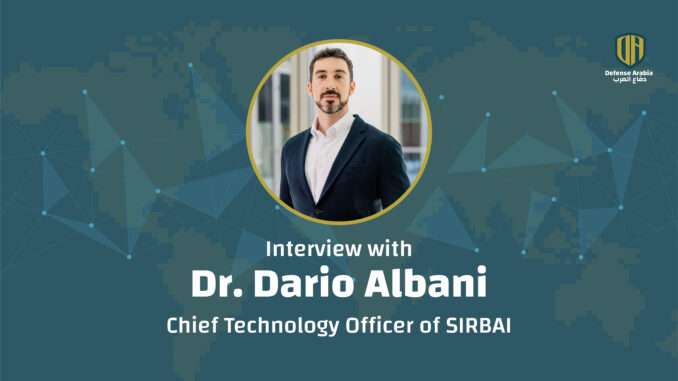
At UMEX, the region’s premier exhibition for unmanned systems, AI, and robotics, SIRBAI made its official debut with an ambitious vision: bringing large-scale swarm intelligence to real-world operations. In this interview, Dr. Dario Albani, Chief Technology Officer of SIRBAI, explains why the company chose UMEX as its launch platform, how its partnership with EDGE accelerates next-generation autonomous capabilities, and what truly decentralized drone swarms mean for modern defense operations. From operating under GPS denial and electronic warfare to autonomous decision-making and manned-unmanned teaming, Dr. Albani offers rare insight into how AI-driven swarms are reshaping the future of aerial missions.
Q: Why have you chosen UMEX as the platform for launching this company?
A: UMEX is the largest exhibition of its type in the region, and one of the largest exhibitions in the entire field, making it a real showcase for us to display our innovative AI system to leaders and specialists across the industry. The event is dedicated to the unmanned systems sector, AI and robotics, which meant it was the perfect launchpad. SIRBAI is the first company in the Middle East focusing only in providing swarm intelligence at scale and our presence at UMEX gave us an unparalleled opportunity to showcase and engage directly with key industry players.
Q: How does the partnership with EDGE advance SIRBAI’s mission?
A: This partnership helps us to advance our mission by combining SIRBAI’s advanced swarm technologies and mission intelligence with EDGE’s versatile suite of UAVs. Together we can deliver a unified and robust solution for a wide range of complex missions while advancing SIRBAI internal portfolio. Ultimately, teaming up with EDGE helps us expand our reach and strengthens our technical capabilities ensuring we can both lead the way in next-gen aerial defense.
Q: If the drones lose contact with the ground station, how do they agree on a plan?
A: The SIRBAI system uses distributed and decentralized swarm intelligence to continue and coordinate drone missions autonomously, even when contact is lost with the central operator. It means SIRBAI can work under electronic attack, GPS denial, in degraded environments or even during jamming.
Q: When GPS is jammed, how exactly do they find their way? Do they use cameras to map the terrain, or do they ping each other to calculate position?
A: Our system is designed for reliable use in all sorts of scenarios, particularly the system can be equipped with specific payloads that allow the UAVs to navigate using vision, satellite imagery, and more.
Q: When the swarm changes the plan on its own, does it tell the operator why it made that choice?
A: The operator is continuosly provided with real-time situational awareness and oversight over the mission. The technology also provides AI-assisted mission planning and that, combined a user-friendly interface, is designed to reduce the cognitive load of the operator.
Q: Which market segments are you targeting with this new product?
A: Primarily the defense and security market for now, particularly intelligence, surveillance, reconnaissance, search and rescue, perimeter and infrastructure protection, convoy and asset security, suppression of enemy air defenses, and manned-unmanned teaming. However, there is nothing stopping us from branching out from the military and into border security, disaster response, critical infrastructure protection and humanitarian missions.


Be the first to comment