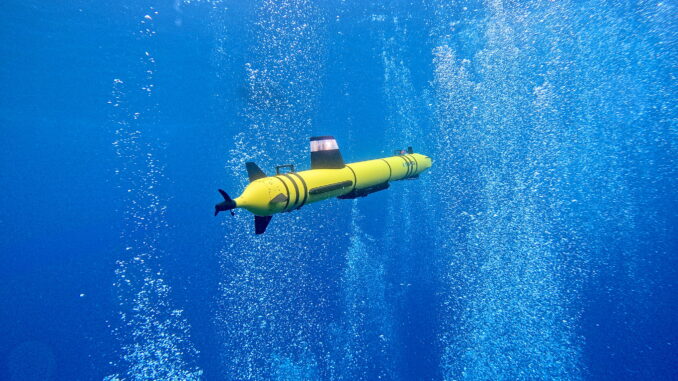
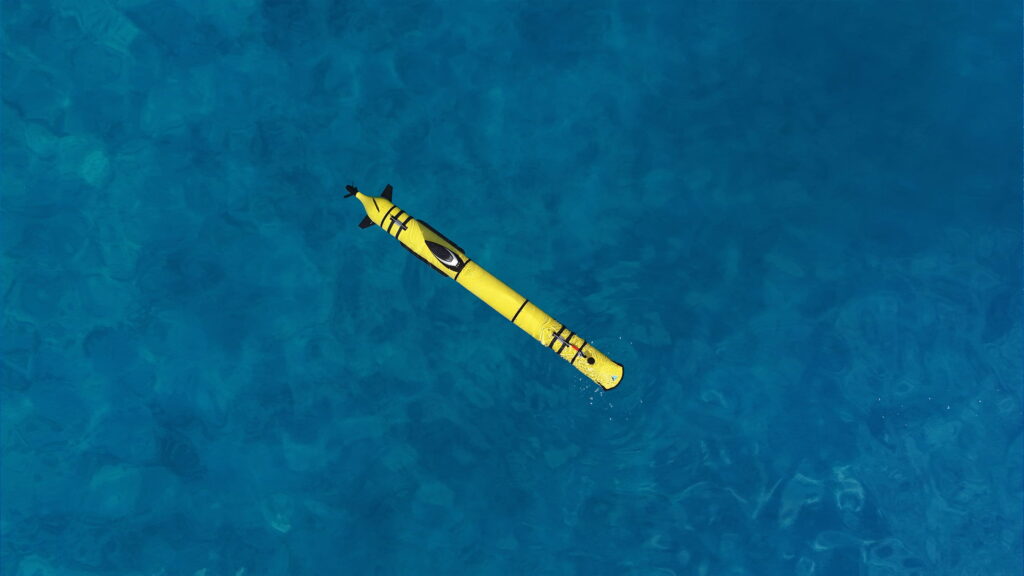
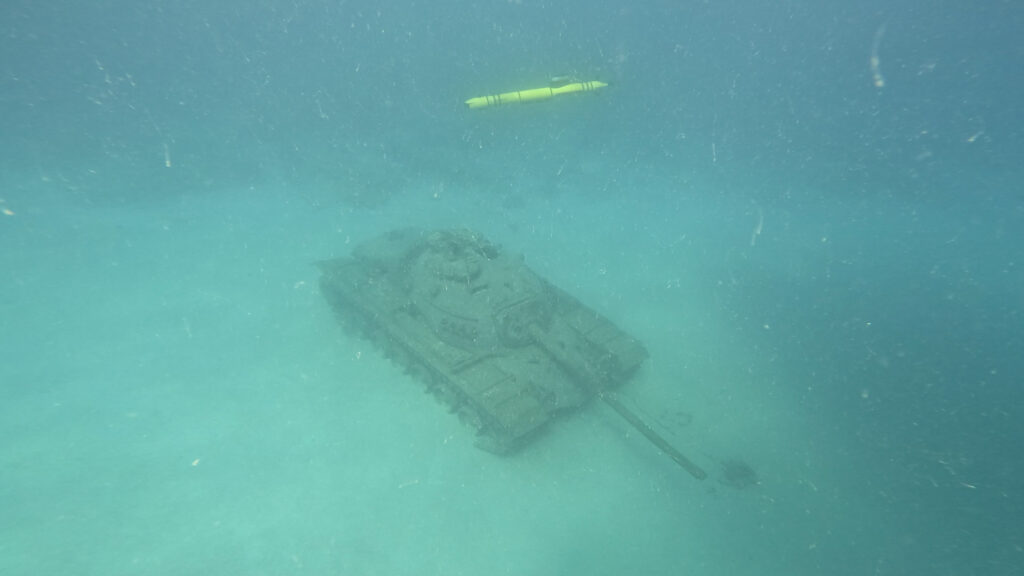
STM’s autonomous unmanned underwater vehicle, STM NETA 300, successfully captured images of a sunken tank during an autonomous underwater reconnaissance mission near Güvercin Island, off the coast of Kaş, Antalya, Türkiye.
STM Savunma Teknolojileri Mühendislik ve Ticaret A.Ş., one of Türkiye’s leading defence engineering companies, continues to demonstrate its capabilities in autonomous underwater technologies across diverse operational environments. STM NETA 300, the first member of STM’s Autonomous Unmanned Underwater Vehicle (AUV) family, recently conducted an autonomous underwater reconnaissance mission near Güvercin Island, off the coast of Kaş, Antalya, Türkiye.
Operating in an area of the Mediterranean known for its rich marine biodiversity and underwater wrecks, STM NETA 300 conducted search and rescue, wreck detection and identification activities, surveying the underwater environment using its advanced sonar systems and high-resolution imaging capabilities. During the mission, the vehicle successfully captured images of a sunken tank, demonstrating its autonomous reconnaissance, underwater object detection and imaging capabilities under real-world maritime conditions.
The tank captured in images by STM NETA 300 had previously served in the Turkish Armed Forces and was deliberately submerged off Güvercin Island in Kaş in 2017, following the end of its service life, to promote diving tourism and create an artificial reef.
Güleryüz: Advancing the Future of Autonomous Maritime Operations
Highlighting the growing importance of unmanned maritime systems in future naval operations, Özgür Güleryüz, General Manager of STM, stated:
“The maritime security landscape is undergoing a significant transformation driven by advances in autonomous technologies. At STM, we combine our extensive naval engineering expertise with artificial intelligence and autonomy to develop next-generation maritime systems. The recent autonomous reconnaissance mission conducted by STM NETA 300 in the Mediterranean demonstrates the capabilities of our underwater technologies in real-world operating conditions. Developed within a short timeframe, STM NETA 300 represents the first platform in our expanding family of unmanned maritime systems.
Building on this foundation, we have expanded our portfolio with TENGİZ, our Extra Large Unmanned Undersea Vehicle (XLUUV), and STM YAKTU, our kamikaze unmanned surface vehicle, offering solutions for a wide range of underwater and surface missions. We remain committed to advancing autonomous maritime technologies that will shape future naval operations and enhance the operational capabilities of the Turkish Navy and our international partners.”
STM NETA 300 Demonstrates Autonomous Mine Detection Capabilities During Naval Exercise
STM NETA 300 previously demonstrated its operational capabilities during the TURNAs-2026 naval exercise held in Antalya in October, participating in advance force operations. Equipped with advanced sonar systems and high-resolution sensors, the vehicle autonomously detected and identified mines and mine-like underwater threats along the transit route, contributing to the safe passage of main naval units and successfully completing its mission. During the exercise, STM NETA 300 also conducted underwater scanning and detection activities as part of seabed warfare operations, supporting critical infrastructure security and underwater pipeline inspections. These missions further demonstrated the vehicle’s capabilities in supporting Mine Countermeasures (MCM) operations and enhancing the safety of naval operations.
Up to 24 Hours of Operation at Depths of 300 Metres
Named after the maritime term “NETA”, meaning smooth, safe and always ready, STM NETA 300 features a compact, modular design that allows it to be transported by two personnel. The vehicle can operate at depths of up to 300 metres, reach speeds of up to 5 knots and achieve a mission endurance of up to 24 hours, depending on its battery configuration.
Designed to support Mine Countermeasures (MCM) operations, STM NETA 300 autonomously surveys suspected minefields using Side Scan Sonar and Gap Filler Sonar, enabling operators to detect, classify and identify mines and mine-like objects quickly and efficiently. Optional Synthetic Aperture Sonar (SAS) integration provides wider area coverage and higher along-track resolution.
STM NETA 300 Secures First Contract, Set to Join Turkish Navy
With its flexible and modular architecture, STM NETA 300 supports a broad range of military missions, including Intelligence, Surveillance and Reconnaissance (ISR), Rapid Environmental Assessment (REA), Anti-Submarine Warfare (ASW), Explosive Ordnance Disposal (EOD) and port security. Civilian and industrial applications include seabed assessments, pipeline inspections, geophysical surveys, offshore renewable energy infrastructure inspections and marine archaeology.
STM has also signed its first domestic sales contract for STM NETA 300, which is set to enter service with the Turkish Navy.


Be the first to comment