Syed Ali Abbas
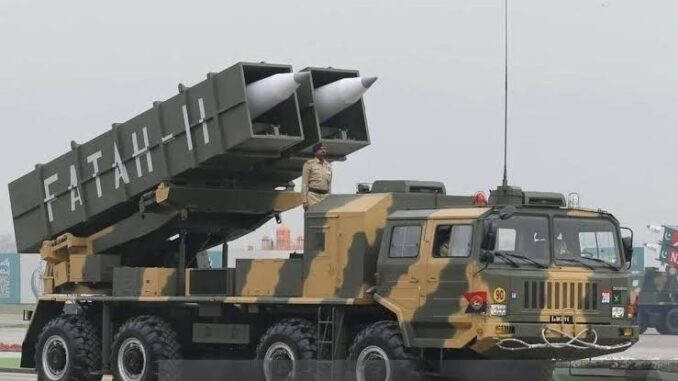
On 13 October, Pakistan’s military media wing (ISPR) announced the test of the Fatah-2 ER, an extended-range variant of the Fatah-II, describing it as a hypersonic ballistic missile designed to defeat missile defences through its trajectory and manoeuvrability. The recently established Army Rocket Force Command (ARFC) conducted the launch. The test came a week after the Fatah-IV-ER flew on 6 October, and fourteen months after the command was created. Together with the lessons of the May 2025 conflict with India, the Iran-US war and the pace of India’s own precision-strike and drone build-up, these tests show that the ARFC is now an active and expanding conventional strike arm of the Pakistan Army.
How the ARFC came to be
On 13 August 2025, Prime Minister Shehbaz Sharif announced the ARFC, which resulted in the integration of ground-launched conventional missiles under one command. It recognised that long range precision firepower was no longer at the periphery of the military, but at its core. The operational rationale provided by the conflict of May 2025. The conflict became a standoff after the air engagement of 7 May with Pakistani air defence maintaining a creditable record of defence against Indian aircraft. India launched BrahMos cruise missiles and loitering munitions against targets in Pakistan. The Army lacked any independent long range conventional strike capability, relying instead of the Air Force, the latter would introduce the coordination challenges and the reduced decision time. The ARFC was supposed to fill this void and allow the Army to go to the entire depth of the battlefield.
The ARFC does not command Pakistan’s nuclear weapons. Those are part of the Army Strategic Forces Command (ASFC) in the National Command Authority (NCA) setup, whereas the Fatah series, along with the Babur-derived cruise missile family, are managed by the ARFC. It allows Pakistan to signal, deter and if required, to strike at the conventional level without the ambiguity that nuclear signalling would allow. Lieutenant General Muhammad Ishaq Khattak, who was Director General Weapons Development at the Strategic Plans Division, is the first named commander of the command and Major General Ameer Muhammad Umrani is the chief of staff.
An accelerating test programme
Pakistan has conducted at least four publicly announced missile tests this year, and at least seven overland NOTAM alerts suggest further unannounced activity.
In April, the ARFC conducted a training launch of the Fatah-II, a 400-kilometre supersonic guided missile developed by NESCOM with advanced avionics, the first launch since the system was upgraded from rocket to missile. In May, it launched the Fatah-IV, a 750-kilometre ground-launched cruise missile with a maximum altitude of 50 metres, a 330-kilogram blast fragmentation warhead and an accuracy of within five metres. The Fatah-IIIsupersonic cruise missile was unveiled on 7 May. On 6 October, Pakistan test-fired the Fatah-IV-ER, an extended-range variant. The ISPR said the trial validated performance at extended ranges with upgraded subsystems, without giving the range, which analysts assess to exceed 1,000 kilometres.
The hypersonic label on the Fatah-2 ER is the most consequential capability claim in the programme. If accurate, it marks a qualitative shift beyond extended range, a flight regime built to complicate India’s layered air defences, including its S-400 batteries. Fatah-2 ER is an extended-range evolution of a manoeuvring quasi-ballistic missile with a separating glide vehicle. The hypersonic claim is official and rests on the combination of high terminal speed and evasive trajectory rather than a newly verified HGV-class weapon with published data.
Strike architecture and the Indian context
The Fatah series now spans four confirmed variants, from 140 kilometres to more than 1,000. Across that range, the series puts most of India’s strategic depth, including airbases, logistics hubs, ammunition depots and command infrastructure, within conventional range. The message is that Indian conventional action will invite precision retaliation at operational depth as well as at the forward edge.
India’s trajectory strengthens the rationale. It allocated $234m to a Drone Incentive Programme, opened drone warfare schools across its services and held a tri-service Cold Start drone exercise in October 2025 that tested drone and counter-drone coordination. An adversary building persistent ISR, networked targeting and precision strike across several services must be deterred at every depth.
India is also working towards a rocket force of its own, by a different route. On 13 January 2026, Army Chief General Upendra Dwivedi called such a force “the need of the hour”, observing that the line between rockets and missiles has blurred. He said it would initially sit under the artillery, while the Chief of Defence Staff has proposed a tri-service version. No raising order has been announced, and India has yet to create an integrated rocket force.
The hardware is moving faster than the structure. In January 2026, the Army placed an INR 292.69 crore (about $35m) order for Suryastra, an Indian variant of Elbit’s PULS launcher firing rockets of 150- and 300-kilometre range. The Defence Acquisition Council approved long-range guided ammunition for the Pinaka in December 2025, and reports name the Pralay quasi-ballistic missile (150 to 500 kilometres) and the ground-launched BrahMos as the other systems the force would deploy. For Pakistan, the concern is less any single system than these weapons operating under one command, backed by India’s larger ISR and targeting base.
Network and industrial limits
As with any missile force, it can only be as effective as the network it is built upon. Accuracy relies on accurate targeting intelligence and ISR feeds and electronic warfare support working together amidst contested conditions. As the ARFC develops further, it would be natural to move to the protection of launch areas and command nodes with layered counter-drone and air defence cover. It is likely that the ARFC will continue to develop and cover such areas as launch areas and command nodes as well. Test success is not the only thing that is important in industrial depth. Extending ranges towards 1,500 kilometres and fielding enough launchers and missiles requires production at wartime consumption rates. Pakistan has proved its ability to design complex missiles under technological constraints. Like most states, there is little public information available on inventories, launcher numbers and replenishment rates, and these numbers will determine whether a sustained exchange could be supported. The force must invest in continued serial production and reserve stocks, to strengthen its success in any future conflict.
For Pakistan, the ARFC reflects three lessons. The effectiveness of nuclear deterrence was demonstrated in May 2025. To support deterrence, the conventional layer must be strengthened – deterrence requires continual updating. The ARFC is a good step towards expanding Pakistan’s credible conventional means as India strives to create space below the nuclear threshold. The Iran-U.S. conflict demonstrated that persistence is the key, combination of integration and mass can weaken even high-tech defenses and Ukraine proved that missiles and drones are vital to creating the operational environment.
Pakistan’s direction and institutional foundations are genuine. Though, it will take time to build the inventory depth, network integration and industrial capacity. Pakistan has been a follower of the policy of strategic restraint in South Asia and ARFC follows in the same spirit of strategic restraint. It increases options at the bottom tier of the escalation ladder, as it reinforces the conventional force side and maintains nuclear forces distinctly separate. Meanwhile, as regional environment continuously gets challenging, the Confidence-building measures between the two states would be welcome, and would serve the wider aim of lasting peace in the region.


Be the first to comment