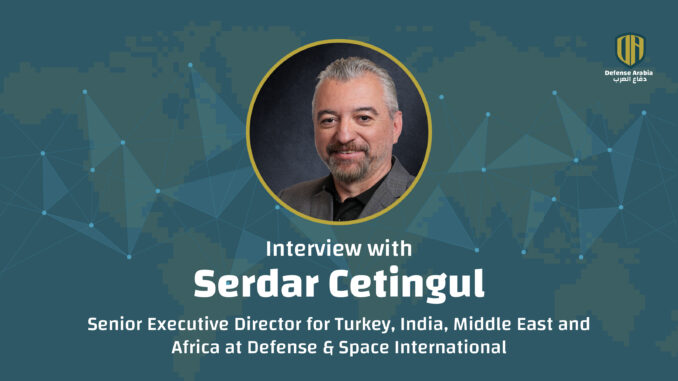
Honeywell Aerospace has entered a new chapter as an independent aerospace and defense company, just as governments across the Middle East are pushing to build sovereign capability, strengthen readiness and localize their defense industries. In this interview with Defense Arabia, Serdar Cetingul, Senior Executive Director for Turkey, India, Middle East and Africa at Defense & Space International, explains what the company’s sharper focus means for defense customers seeking faster modernization. He outlines Honeywell’s approach to local supply chains, MRO and industrial partnerships, and why skills development and knowledge transfer are central to lasting localization. He also discusses the role of autonomous systems, the importance of resilient navigation in contested environments, and the technologies he expects to reshape defense aviation over the next decade.
Serdar Cetingul, Senior Executive Director, Turkey, India, Middle East and Africa, Defense & Space International, Honeywell Aerospace
- Honeywell Aerospace is now an independent aerospace and defense company. What does that sharper focus enable you to do differently for defense customers, particularly those seeking faster modernization, greater readiness and long-term technology partnerships?
Becoming an independent company gives us an even clearer focus on aerospace and defense. It allows us to align our strategy, investments and operating priorities directly with the needs of our customers and the missions they support.
For defense customers, the real value is not the corporate structure itself. It is what that focus enables: closer customer alignment, faster decision-making, disciplined investment in innovation, and stronger operational execution. Our customers are modernizing existing fleets while developing new platforms, often under significant time and readiness pressures. We can support both requirements through a broad portfolio of mission-critical technologies spanning avionics, propulsion, power and thermal management, flight controls, navigation, sensors, connectivity and aftermarket support.
We also bring a “develop once, deploy everywhere” approach, adapting proven technologies across platforms and missions. That can reduce development risk and help customers field dependable capability more rapidly. Our objective is to be more than an equipment supplier. We want to be a long-term, mission-focused partner that supports the customer from initial platform design through sustainment and future upgrades.
- Across the Middle East, governments increasingly view localization as a way to strengthen readiness, resilience and sovereign capability. How does Honeywell Aerospace approach localization, including local supply chains, MRO and industrial partnerships?
We see effective localization as a long-term capability-building journey, not simply the transfer of a narrowly defined activity. Across the Middle East, this means working with customers and local industry to identify opportunities that strengthen in-country capabilities, support fleet readiness and contribute to long-term industrial development. It begins with understanding each country’s priorities, current industrial base, skills, platform needs and long-term ambitions.
From there, the right model may include developing qualified local suppliers, establishing repair and maintenance capability, supporting assembly or integration, collaborating on engineering and, where appropriate and permissible, exploring co-development or licensed production. The approach needs to be phased, commercially sustainable, and built around quality, safety, regulatory compliance, and protection of sensitive technology.
MRO is particularly important because local maintenance capability has a direct connection to fleet availability and mission readiness. But a sustainable MRO ecosystem requires more than equipment. It needs trained personnel, approved processes, tooling, technical data, quality systems, supply-chain access, and a predictable volume of work. Global technology companies can contribute by working with local partners to build those elements progressively, while helping connect local capability to international aerospace standards.
The result we should aim for is a locally rooted ecosystem that can support aircraft throughout their lifecycle, create skilled employment, and become progressively more competitive.
- Infrastructure alone does not create a sustainable aerospace ecosystem. How do skills development, engineering collaboration and knowledge transfer fit into Honeywell Aerospace’s localization model?
People are the foundation of sustainable localization. A facility or production line creates lasting value only when local teams have the skills, systems and experience to operate it safely, improve it and eventually develop new capability around it.
That is why talent development should be built into an industrial partnership from the beginning. Depending on the program, this can involve technical training, certification pathways, mentoring, joint engineering, hands-on experience, university collaboration and opportunities for local personnel to work alongside experienced Honeywell Aerospace specialists.
Knowledge transfer also needs to be outcome-based. It is not only about delivering classroom training or documentation. It is about enabling people to diagnose problems, make sound engineering decisions, manage quality, support customers, and continuously improve performance. For defense operators, developing local engineering and maintenance expertise can help improve fleet availability, reduce reliance on overseas support and strengthen long-term operational resilience.
Over time, this creates a multiplier effect. Local engineers and technicians support current fleets, strengthen the supplier base and become the talent pipeline for future indigenous platforms.
- Autonomous and uncrewed systems are moving rapidly from experimentation into operational use. Where do you see the most important defense applications, and why will resilient navigation be critical to their success in contested environments?
The greatest opportunity is not autonomy for its own sake. It is autonomy applied to missions where it can improve reach, persistence, speed, survivability, or safety.
That includes intelligence, surveillance and reconnaissance; logistics and resupply; collaborative operations between crewed and uncrewed aircraft; protection of critical infrastructure; and missions in challenging or high-risk operating environments. Over time, human-machine teaming could increasingly allow operators to manage multiple assets and concentrate on higher-level mission decisions.
For that potential to be realized, autonomous platforms must remain dependable when conditions become difficult. Navigation cannot rely on a single source. In a contested environment, satellite navigation may be jammed, spoofed, degraded, or unavailable. Resilient navigation therefore combines inertial navigation with complementary sources such as vision, radar, radio-frequency signals, terrain information, or other alternative navigation inputs.
The objective is to provide trusted position and timing information so that platforms can continue operating safely and predictably, with appropriate human oversight and defined mission boundaries. At Honeywell Aerospace, we are advancing resilient navigation technologies that combine inertial systems with alternative navigation inputs, helping operators maintain reliable positioning when traditional satellite signals are disrupted.
- Beyond autonomy, which technology areas will most reshape defense aviation over the next decade, and how is Honeywell Aerospace deciding where to focus its innovation?
Several technology areas will develop together rather than independently.
· First, resilient navigation, sensing, and secure connectivity will be essential as forces operate across increasingly contested domains.
· Second, artificial intelligence and advanced computing will help platforms process more information at the edge and support faster, better-informed decisions.
· Third, power and thermal management will become increasingly important as aircraft carry more demanding sensors, mission computers and electronic systems.
· Fourth, propulsion, electrification, and advanced actuation will influence the range, efficiency and affordability of both crewed and uncrewed platforms.
· Finally, open and upgradable architectures will help customers introduce new capability without replacing an entire platform.
Our innovation focus starts with the mission problem. We look for technologies that can improve readiness, survivability, safety and effectiveness, and that can be adapted across multiple platforms. This approach is reflected in our work on resilient navigation systems and propulsion technologies for next-generation uncrewed aircraft, where reliability, performance and operational flexibility are critical. We also engage early with platform developers and local partners because the greatest impact often comes when technologies are considered before the aircraft configuration is locked.
The next decade will favor solutions that are not only advanced, but also practical to deploy, maintain and upgrade. Innovation must therefore be supported by manufacturing capacity, cybersecurity, supply-chain resilience and long-term sustainment, while accounting for the regulatory requirements of different markets.


Be the first to comment