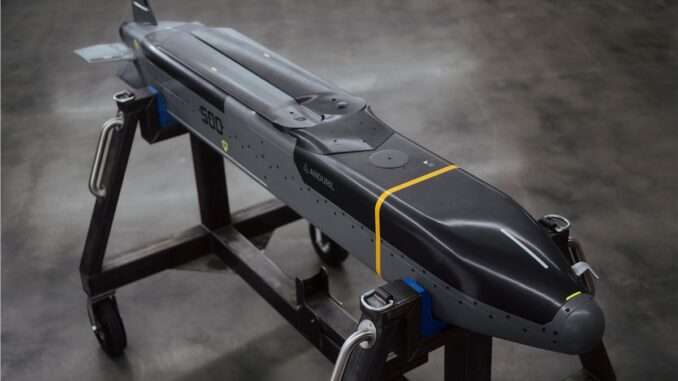
America and its allies need weapons that can adapt as quickly as the threats they are built to defeat. That demands a new class of weapons that has been designed from first principles to be modular, upgradeable, and responsive to rapid technological evolutions and changing battlefield realities.
In November 2025, the Secretary of War called on industry and the Department of War to make modularity a priority for weapons development. “Imagine being able to swap parts or software of a critical munition without needing to completely redesign the missile,” he said. “It’s common sense, but we’re not doing it.”
Less than a year later, the U.S. Air Force Research Laboratory (AFRL) and Anduril Industries have demonstrated that approach on a weapon moving into large-scale production.
Following rigorous independent testing by the Munition Open Architecture Test and Evaluation Laboratory (MOATEL), AFRL has verified that Anduril’s Barracuda-M family of affordable, mass-producible cruise missiles is compliant with the Air Force’s Weapon Open Systems Architecture (WOSA) standard. Barracuda is the first weapon system in large-scale production to complete MOATEL’s independent WOSA verification process.
Verifying Openness
In partnership with industry, WOSA establishes common interfaces that allow weapon subsystems — including seekers, navigation modules, software, payloads, and more — to be developed, integrated, and upgraded independently. Instead of redesigning an entire weapon around a new component, WOSA enables programs to integrate new technology through defined interfaces as mission requirements, threats, and technology evolve. Located within AFRL’s Air Warfare Directorate, MOATEL provides independent testing against those requirements, providing government program offices and industry a common means of determining whether a weapon conforms to the WOSA standard.
“Open architecture is only meaningful when it can be independently verified, and for WOSA that verification is through MOATEL” said Jonathan Shaver, program manager and creator of Weapons Open Systems Architecture, Air Force Research Laboratory Air Warfare Directorate. “Through MOATEL, AFRL owns that verification for WOSA, assessing whether a weapon actually meets the standard instead of accepting vendor self-assessment. WOSA and MOATEL under AFRL is what lets us take new S&T, prove it in the laboratory, and make it ready to integrate on a weapon. This is showing that open architecture can scale beyond prototypes. Without that independent path from S&T to MOATEL, the industrial base cannot deliver new technology to the warfighter at the speed the fight requires.”
In partnership with AFRL, Anduril recently completed a four-day MOATEL verification assessing 14 WOSA domains: Mission Autonomy, Seeker, IMU, GPS, Air-Data Sensor, Propulsion, Airframe Control, Target State Estimator, Altimeter Aiding Nav, Clock, Autopilot, Guidance, Navigation and Munitions Data Bus (MDB). The test demonstrated modularity between Anduril’s internal and external MDB implementations, enabling rapid tech refresh of WOSA-compliant software. The assessment verified that Anduril’s software architecture meets the WOSA requirements for the domains under test. Because the architecture is modular and configurable, the same solution can be deployed across multiple weapon platforms. That combination of independent verification, reduced integration risk, and reuse will give current and future weapons programs a faster path from new technology to the warfighter.
“It’s easy to talk about modularity and open architectures in the abstract. Proving it through an independent assessment is harder,” said Pat Morris, VP of Advanced Effects at Anduril. “AFRL and MOATEL’s verification validates one of the fundamental design decisions behind Barracuda: build the weapon around a simple, modular architecture so that programs can integrate new technology without redesigning the entire system. That matters because the Barracudas we produce today need to remain relevant as threats, technology, and mission requirements change.”
Open Architecture at Production Scale
The significance of this verification is not limited to a prototype or a laboratory experiment. Anduril is on contract to deliver multiple Barracuda variants to customers across the Department of War, with plans to produce several thousand Barracuda systems annually over the next several years. Barracuda production is already underway and the first customer deliveries will begin in early 2027. MOATEL’s assessment ensures that each of those programs will be able to update and upgrade Barracuda as new mission requirements and technologies emerge.
As Barracuda moves into production, delivery, and operational fielding, the validated WOSA architecture provides a foundation for the thousands of weapons produced over the coming years to evolve alongside the missions they are built to perform.


Be the first to comment