
Exclusive. Defense Arabia
Air forces and defense planners worldwide are grappling with an increasingly unsustainable arithmetic problem: how do you stop a drone that costs no more than a few thousand dollars without spending a sum that dwarfs its value many times over? This lopsided calculation, laid bare by waves of drone attacks over Ukraine and the Red Sea, has pushed a growing number of militaries toward a technology that once belonged to science fiction and is now a tested reality on the battlefield. We are talking about the high-energy laser.
From Warhead to Heat: How Laser Interception Actually Works
Laser interception operates on a fundamentally different principle than a conventional missile. Rather than launching an explosive warhead toward a target, a laser engagement unfolds as a sequence of distinct stages, from detection through to destruction.
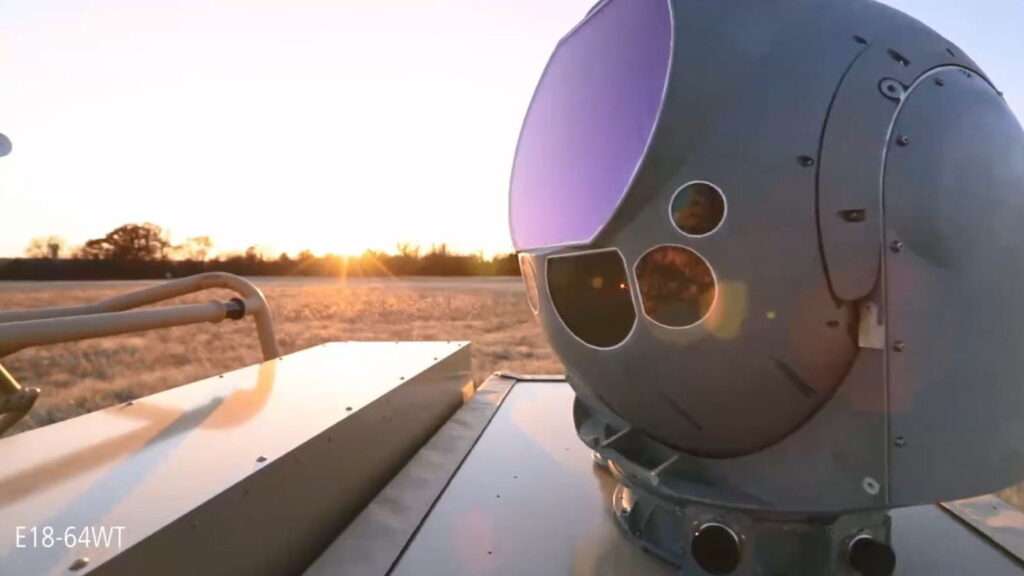
Surveillance radars and electro-optical sensors first spot the hostile drone, establishing its speed, heading, and altitude with precision. A beam director, a rotating telescope fitted with steerable mirrors, then locks a tracking beam onto the target and holds it there, compensating continuously for the drone’s maneuvers as well as for vibration in the platform carrying the system itself, whether a ship, a vehicle, or a fixed ground installation.
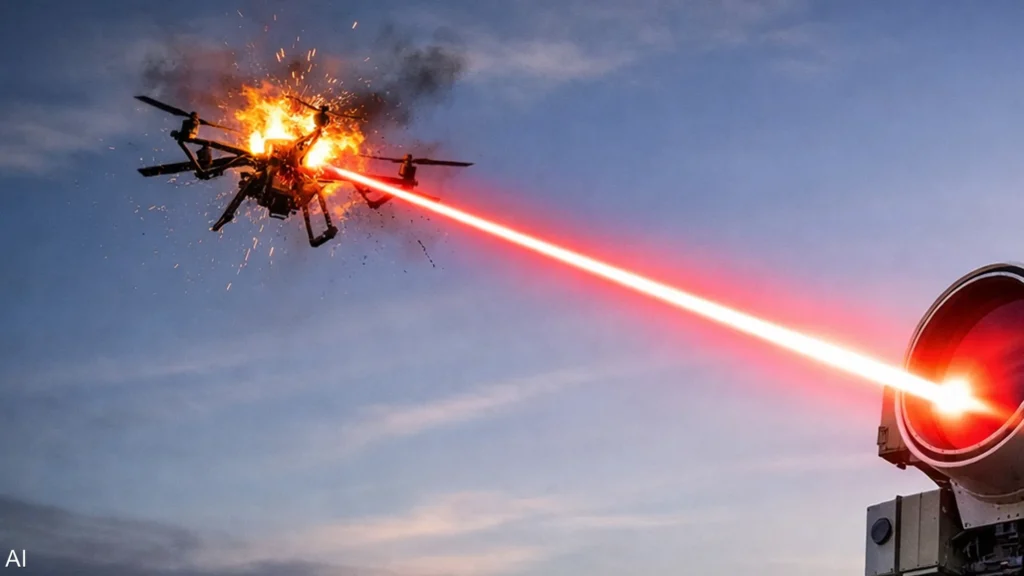
Most modern systems rely on fiber laser architecture, in which several individually modest-power beams generated in separate laser modules are combined through the same shared telescope into a single focused point on the target, together producing a combined output that can exceed 100 kilowatts. Once the beam is fixed on a chosen vulnerable point on the drone’s airframe, typically its motor, battery, or fuselage cavity, what is known as dwell time begins: a window lasting anywhere from a few seconds to slightly longer, during which thermal energy is concentrated relentlessly on the same spot until the material melts or the internal circuitry burns out, bringing the target down or disabling it entirely.
A laser weapon’s architecture rests on four integrated subsystems: a power unit that converts electricity from the platform’s generators or lithium batteries into the voltage the laser requires; a thermal management unit that dissipates the substantial waste heat produced because electrical-to-optical conversion efficiency rarely exceeds 50 percent; a beam control and tracking unit responsible for optical precision; and finally the laser source itself. Because the “ammunition” here is electricity rather than a stored round, these systems are often described as having a stockpile that never runs dry, provided sufficient power and cooling remain available. That is precisely why the full operational chain, detection, tracking, and engagement, matters more in evaluating any laser system than the raw power figure of the laser itself.
Germany Moves from Demonstrator to Production
Germany offers one of the clearest illustrations of how far this technology has advanced beyond the test range. On July 9, 2026, Germany’s federal defense procurement office signed a contract worth 462 million euros (roughly 540 million dollars) with a consortium of Rheinmetall and MBDA Deutschland to develop and build a complete high-energy naval laser system for the German Navy, with entry into service targeted for 2029.
The award builds on years of successful sea trials aboard the frigate Sachsen, during which a demonstrator fired more than 1,000 shots at airborne, surface, and land-based targets across more than 28,000 nautical miles in the North Sea, Baltic Sea, and Mediterranean, including engagements under adverse weather conditions. The current demonstrator operates at roughly 20 kilowatts, while future production versions are intended to exceed the 100-kilowatt threshold to handle faster, more demanding threats.
Real Savings, or a Statistical Illusion?
These impressive figures conceal a fundamental caveat that often goes unmentioned when the technology is being sold to policymakers. While the marginal cost of a single “shot” falls to little more than the price of the electricity consumed, a complete system still carries a price tag running into the hundreds of millions of euros, and that figure covers only one program currently in development. Because comprehensive defensive coverage requires equipping an entire fleet, the real economic payoff lies not in the total program cost but in the marginal cost of each individual intercept over the long run, a distinction that matters enormously when weighing any laser program against the cost of maintaining a conventional missile stockpile.
A Global Race: From Britain to American Bases
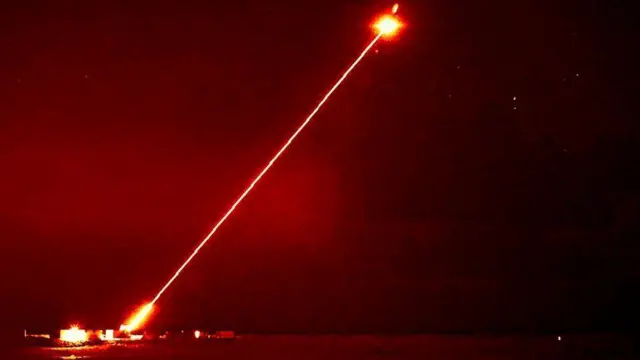
Germany is far from alone in this bet. Britain’s Ministry of Defence has awarded a 316 million pound contract to MBDA UK, working alongside Leonardo UK and QinetiQ, to fit the DragonFire directed-energy weapon aboard Type 45 destroyers starting in 2027, following trials in October 2025 in which the system successfully downed drones flying faster than 650 kilometers per hour.
In the United States, the Army has launched its E-HEL program to develop enduring laser platforms for counter-drone missions, while AeroVironment unveiled the third generation of its LOCUST laser family, LOCUST X3, in March 2026, scalable between 20 and 35 kilowatts. In May 2026, the U.S. Department of War selected five military installations to trial high-energy laser and high-power microwave weapons under a pilot program aimed at reducing reliance on conventional interceptor missiles, while the Navy separately tests comparable capability through its HELIOS and ODIN systems aboard carriers and destroyers.
The Limits of Physics: Weather, Heat, and Dwell Time
The laws of physics impose constraints that no amount of investment can simply engineer away. Beam effectiveness drops sharply in rain, fog, or dust as thermal energy scatters through the atmosphere in a phenomenon known as thermal blooming. The nature of the technology also forces the system to engage one target at a time, limiting its ability to counter a full drone swarm attacking simultaneously. Add to that the substantial demands on electrical generation and cooling infrastructure, along with a strictly line-of-sight engagement envelope, and it becomes clear why lasers function as a complementary tool rather than a wholesale replacement for existing missile and gun-based air defenses.
A Layer, Not a Silver Bullet
Military officials and technical experts broadly agree that lasers will not eliminate the need for interceptor missiles and kinetic defense systems. Instead, they are expected to absorb the bulk of cheap, repetitive threats, freeing up costly missiles for more demanding targets such as ballistic and cruise missiles. As German, British, and American investment accelerates, and as additional countries including Turkey and South Korea join the race, current trends suggest this decade will see lasers move from a showcase technology to a foundational layer of air defense across most of the world’s militaries, provided the weather and power constraints that still limit their full deployment can eventually be overcome. The question hanging over military decision-makers in the region and beyond remains unresolved: will today’s armed forces settle this technological race before cheap drones overwhelm laser defenses through sheer numbers, or will the low marginal cost of interception become the decisive edge that tips the balance in the defender’s favor?




Be the first to comment