
Waleed Sami
Only one day separated two military events that appeared, on the surface, to be entirely unrelated. Yet their precise chronological sequence has reopened the question of how the defense balance around Egypt is evolving between Beijing and Paris, at a moment when major strategic interests are converging over Egyptian territory and the Mediterranean airspace.
An Air Exercise Reveals Its Significance
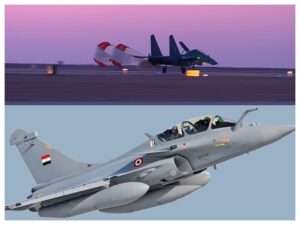
The “Eagles of Civilization 2026” exercise officially began on August 22, 2026, marking its second edition following the 2025 exercise, in which China participated with J-10C fighter jets. This year, however, Beijing raised the level of its participation by deploying the heavier and more advanced J-16 fighters.
The first training day featured direct air-combat engagements between Chinese J-16s and Egyptian MiG-29 and Rafale fighters. On August 23, the Chinese Ministry of National Defense officially confirmed that the J-16s had conducted medium- and close-range air-combat training specifically against Rafale fighters, marking the first documented engagement of its kind between the two aircraft.
The encounter carries significance for both sides. For China, it provides a rare opportunity to assess the performance of its combat platform against one of the most capable Western fighter aircraft operating in the region. For Egypt, meanwhile, it offers direct exposure to modern Chinese platforms and tactics, including the KJ-500 airborne early warning aircraft, the YY-20A aerial tanker, and the Y-20A strategic transport aircraft. Together, these assets represent an integrated combat system rather than a merely symbolic deployment.
A High-Level Visit to Cairo Just Hours Later
The following day, August 24, 2026, General Fabien Mandon, Chief of Staff of the French Armed Forces, arrived in Cairo at the head of a high-level military delegation.
His meetings were not merely ceremonial. Mandon met with General Ashraf Salem Zaher, Commander-in-Chief of the Egyptian Armed Forces and Minister of Defense and Military Production, as well as Lieutenant General Ahmed Khalifa, Chief of Staff of the Egyptian Armed Forces, who also oversaw the official reception ceremony at the headquarters of the Ministry of Defense.
According to the official Egyptian statement, the talks focused on military cooperation between the armed forces of the two countries in support of regional security and stability.
Mandon went further in his remarks, describing the meeting as an important opportunity to exchange views and assessments on developments in Africa and the Middle East. He also emphasized Egypt’s pivotal role at a time of crises and tensions affecting both countries, noting that the Mediterranean represents a geographic space in which the interests of France and Egypt increasingly converge and where frameworks for joint cooperation continue to expand.
Questions Raised by the Timeline
For any close observer of defense affairs, it is difficult to overlook the significance of this sequence of events. Was a visit of this level and importance planned in advance? Most likely, yes. Visits by the French Chief of Staff of the Armed Forces are not arranged overnight.
The more precise question, however, is whether the agenda of such a high-level military meeting could have been adjusted within hours following an operationally significant event such as the J-16’s entry into direct training engagements with the Rafale. In the world of military diplomacy, that possibility cannot be ruled out.
Other questions are equally significant: Was Paris aware in advance that Egyptian Rafales would participate in dissimilar air combat training (DACT) against the J-16? And did Beijing accept this type of operational interaction knowing that Egypt is one of the region’s most important Rafale operators and maintains a long-standing and deeply rooted defense partnership with France?
No Evidence Yet, But the Sequence Deserves Attention
As of now, there is no documented evidence of trilateral coordination among the three parties, nor is there any confirmation of a direct link between the timing of General Mandon’s visit and the Chinese-Egyptian exercise.
Nevertheless, the sequence itself remains striking: a first-of-its-kind air encounter between the J-16 and Rafale on August 23, followed immediately by General Fabien Mandon’s visit to Cairo on August 24, accompanied by official French remarks about exchanging strategic assessments concerning Africa, the Middle East, and the Mediterranean.
It may simply be a coincidence within Egypt’s familiar approach to managing multiple strategic partnerships. But it is a coincidence that warrants close monitoring in the weeks ahead.




Be the first to comment