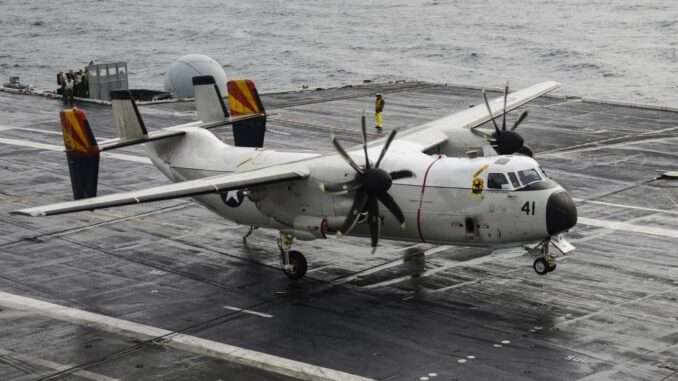
As the U.S. Navy retires the C-2A Greyhound, the aircraft leaves behind a legacy defined by operational reliability and a decades-long partnership between industry and the fleet.
For 60 years, the C-2A Greyhound kept U.S. Navy carrier strike groups supplied, connected and mission-ready. Northrop Grumman developed the aircraft and fielded it in the late 1960s, purpose-building it for the carrier-onboard-delivery (COD) mission: moving personnel, high-priority parts, mail and other critical assets from shore to sea. Across decades of deployments, the Greyhound became a trusted logistics workhorse and a familiar, welcome sight to Navy crews stationed around the world.
A Mission-Critical Link from Shore to Sea
The C-2A’s mission never changed: deliver a fast, reliable logistics link between land bases and deployed carriers. Its large, unobstructed cargo compartment and rear loading ramp gave the aircraft the capacity and flexibility to transport high-value, time-sensitive components such as jet engines and major assemblies, along with maintenance tools, equipment and personnel moving to and from the ship. The Navy also designated the C-2A a special warfare asset, capable of airdropping special operations personnel and gear directly into the water.
By delivering critical parts and people straight to the flight deck, the Greyhound helped carriers stay deployed and operationally effective, in both peacetime and combat.
Built for the Carrier Environment
Engineers designed the Greyhound from the outset around the unique demands of carrier aviation. Its folding wings and onboard auxiliary power unit, which enabled engine starts and ground power self-sufficiency in remote areas, gave it a level of operational versatility unmatched by any other cargo aircraft.
Since entering service, the Greyhound has shared the flight deck with a succession of iconic Navy aircraft, from the A-6 Intruder and F-14 Tomcat to the F/A-18 Hornet and Super Hornet and the fifth-generation F-35 Lightning II. The C-2 also shared 53% of its parts with the E-2 series, which enabled a robust and efficient sustainment model throughout the aircraft’s service life. Continuous upgrades and maintenance kept the platform relevant and effective as carrier operations evolved, new technologies came aboard and global requirements shifted.
Delivering More Than Cargo
For sailors deployed far from home, the C-2A meant more than logistics. It was a tangible connection to life beyond the horizon. Alongside priority cargo and passengers, the Greyhound also carried mail, including care packages that helped crews maintain a sense of normalcy during long deployments. The sound of an approaching C-2 signaled not only the arrival of mission-essential parts, but also small reminders of family and friends back home that helped sustain morale at sea.
For Northrop Grumman, the C-2A’s story reflects a long-term commitment to the fleet and to the company’s broader mission: designing, building and supporting specialized aircraft that let the U.S. Navy project power and stay connected anywhere on Earth.




Be the first to comment