
By Colonel Staff Officer Zafer Mourad
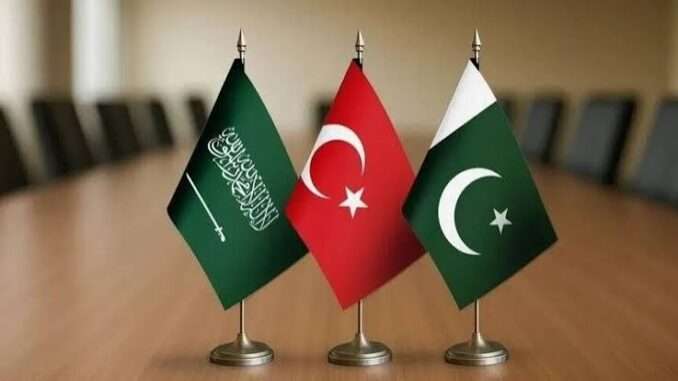
The announcement of the trilateral alliance between Saudi Arabia, Turkey, and Pakistan has sparked wide-ranging debate in strategic circles, raising a host of questions about the alliance’s objectives, its limits, its chances of success, and the challenges it faces. Through this article, Defense Arabia offers a set of answers to these questions, beginning with the central question: does this alliance represent a viable power project, or merely a convergence of interests imposed by the strategic moment? Answering this requires laying out a set of facts and analyses in service of that larger question.
Why now?
This is an obvious question, and it is not enough to simply say the region is passing through a sensitive phase. Rather, one must recognize that five variables have converged for the first time in the region: first, declining confidence and certainty regarding the American security umbrella; second, the crystallization of a conviction that protecting national interests has become a cross-border undertaking that national capabilities alone cannot guarantee, requiring instead a network of external alliances; third, the shift of wars from conventional confrontations to prolonged attrition, which demands a national defense industrial base and strategic defense cooperation; fourth, the accelerating race in military technology (drones, artificial intelligence, electronic warfare) and the need for outside expertise and integration with partners; and fifth, Saudi Arabia’s desire to shift from being an arms importer to a partner in arms production under “Vision 2030.” In this light, the timing of the alliance becomes the product of the convergence of these variables, not merely a reaction to a passing regional crisis.
What are the outer limits of this alliance?
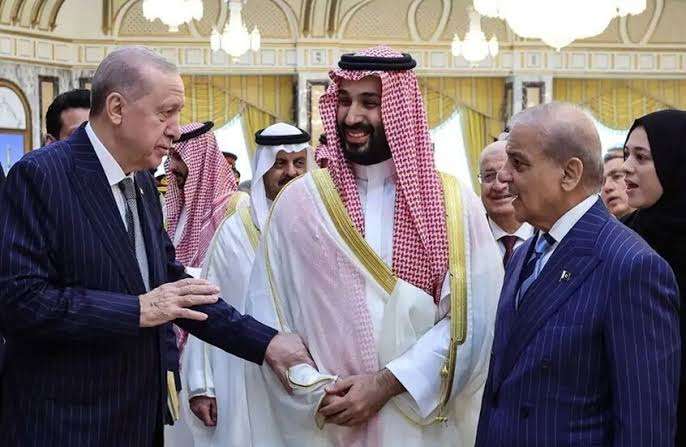
This is a question most intelligence agencies in the region and around the world are asking, seeking to test the alliance’s strength and reach and to read its first practical indicators. The three parties involved each have their own security relationships and military alliances—as well as enemies and rivals—and it is worth noting that not every alliance is capable of becoming a collective defense pact. Turkish Foreign Minister Hakan Fidan has noted that the mutual defense clause in the trilateral agreement closely resembles Article 5 of the NATO treaty, which stipulates that an armed attack against one member state is considered an attack against all member states. This does not obligate every state to become directly involved in a war, but it does place the aggressor in confrontation with the entire alliance and obliges member states to provide the necessary assistance according to the demands of the situation. As for the highest ceiling this alliance could reach, that remains contingent on regional and global circumstances and the degree to which each party’s interests are threatened.
Does geographic distance pose an obstacle?
The problem is not that the countries are geographically distant, but that the threats they face are not identical: Saudi Arabia looks toward the Gulf and the Red Sea, Turkey looks toward the Eastern Mediterranean, the Caucasus, and Syria, and Pakistan looks toward India and South Asia. This means the alliance does not operate within a single theater of operations—a dilemma that differs from NATO, which faces a far more interconnected theater. Nevertheless, geographic distance does not constitute an operational obstacle, particularly with regard to intelligence sharing and military support and cooperation.
Will this alliance hinder its members’ external relations?
Here the challenge of divided strategic loyalties comes into play: Turkey is a NATO member, Pakistan is closely tied to China, and Saudi Arabia is a traditional partner of Washington even as it expands its partnerships with Beijing and Moscow. The difficult question is whether the alliance can withstand a clash of interests among these major powers. It is likely that the alliance’s member states will manage to navigate this dilemma, since the alliance is not fundamentally directed against the major powers, does not touch their vital or existential interests, and does not conflict with their security policies.
Does the alliance aim at integration in defense industries in an era of attrition warfare?
Certainly—this is considered one of its most important rationales, indeed its very core, and the basis for maximizing each party’s strength. In short: Saudi Arabia can offer enormous financial capacity, Turkey offers industrial and military-technological expertise, and Pakistan offers combat experience and nuclear capability, completing the full set of ingredients of power within this alliance.
Does this alliance carry a potential ideological or civilizational dimension?
There is no doubt that the location of the signing in Mecca, the name given to the alliance, the predominant religious identity, and the shared concerns of the member states will lend it an ideological and civilizational dimension that strengthens its cohesion and staying power, within a Middle Eastern political, security, and economic space saturated with religious, civilizational, and ideological considerations.
Where does Egypt stand regarding this agreement?
This is a notable point that deserves calm discussion: does Egypt’s absence represent a temporary choice, or a sign of a different strategic approach? It is likely that certain fundamental issues have not yet been resolved regarding Egypt’s entry into this alliance. Despite the extensive security and defense cooperation already in place with Egypt, the critical strategic moment that necessitated this announcement at this particular time could not wait for every gap to be closed and every detail to be agreed upon before bringing Egypt in—especially since membership would impose obligations and duties in proportion to the opportunities and capabilities it provides. In addition, Egypt’s foreign policy is a cautious one that compels it to wait and observe how successful and influential this alliance proves to be before deciding whether to join.
Whom is this new alliance directed against?
The alliance was not announced as a hostile step against any regional or international party, particularly since it is a defensive rather than an offensive alliance. It is clear, however, that it is directed, in parallel, against the threats posed by terrorists, militias, and organizations operating freely in some countries of the region; against Iran, with the aim of wielding a “big stick” and exerting maximum pressure on it should it attack Saudi security and interests; and against Israel, which continues to escalate its inhumane attacks and its violation of numerous areas, particularly in Gaza, the West Bank, Syria, and Lebanon. It is also worth noting that this alliance aspires to play a regional and international role in the future, particularly in the field of global energy security and the protection of shipping lanes—meaning its members will, through it, enter into the broader equation of regional and global power and influence.
What are the indicators of this alliance’s success, and how can its ability to endure geopolitical and economic pressures be confirmed?
In theory, this alliance is positioned to endure and develop, and it may eventually admit new members such as Egypt, Syria, and the United Arab Emirates. Its announcement was not the product of a sudden moment but was preceded by considerable study, analysis, and planning on numerous issues whose details remain confidential. In practice, there is no doubt it will soon face multiple tests, which will manifest in the observation of unprecedented qualitative capabilities among its member states, particularly Saudi Arabia. This alliance will undoubtedly draw the region into a new power equation that will impose its economic, security, and military rhythm on its future—an equation likely to bring violent, harsh, and decisive confrontations that will impose a new reality for a long period to come.




Since the Biden era, Mohammed bin Salman has pursued a policy of diversifying alliances, no longer relying solely on Washington but opening up more to Moscow,Beiging , and Ankara.
Following the Gaza war, KSA intensified its search for other security partners, and military cooperation with Turkey and Pakistan became more prominent. In the future, Turkey could be viewed as a political partner, Saudi Arabia as a financial partner, and Pakistan as a military partner.
Turkey and Saudi countries also share potential economic cooperation, most notably the Turkey-Saudi Arabia corridor through Syria and Jordan.
In addition to confronting common challenges, particularly separatist movements and armed groups.
Amazing Article btw.
Since the Biden era, Mohammed bin Salman has pursued a policy of diversifying alliances, no longer relying solely on Washington but opening up more to Moscow,Beiging , and Ankara.
Following the Gaza war, KSA intensified its search for other security partners, and military cooperation with Turkey and Pakistan became more prominent. In the future, Turkey could be viewed as a political partner, Saudi Arabia as a financial partner, and Pakistan as a military partner.
Turkey and Saudi countries also share potential economic cooperation, most notably the Turkey-Saudi Arabia corridor through Syria and Jordan.
In addition to confronting common challenges, particularly separatist movements and armed groups.