
The General Manager of Turkey’s Mechanical and Chemical Industry Corporation (MKE), Engineer İlhami Keleş, has revealed details of the remarkable surge his company has achieved in defense exports over recent years, alongside a five-pillar strategic transformation plan that is reshaping the identity of Turkey’s most storied military-industrial institution.
Keleş received Defense Arabia for an exclusive interview on the sidelines of Exercise Efes 2026, hosted by Turkey in May 2026. The conversation covered Turkey’s artillery systems and which among them best suits Arab nations’ needs, the reasons behind the export breakthrough, the company’s future vision, and the role MKE plays in one of the region’s largest multi-domain military exercises.
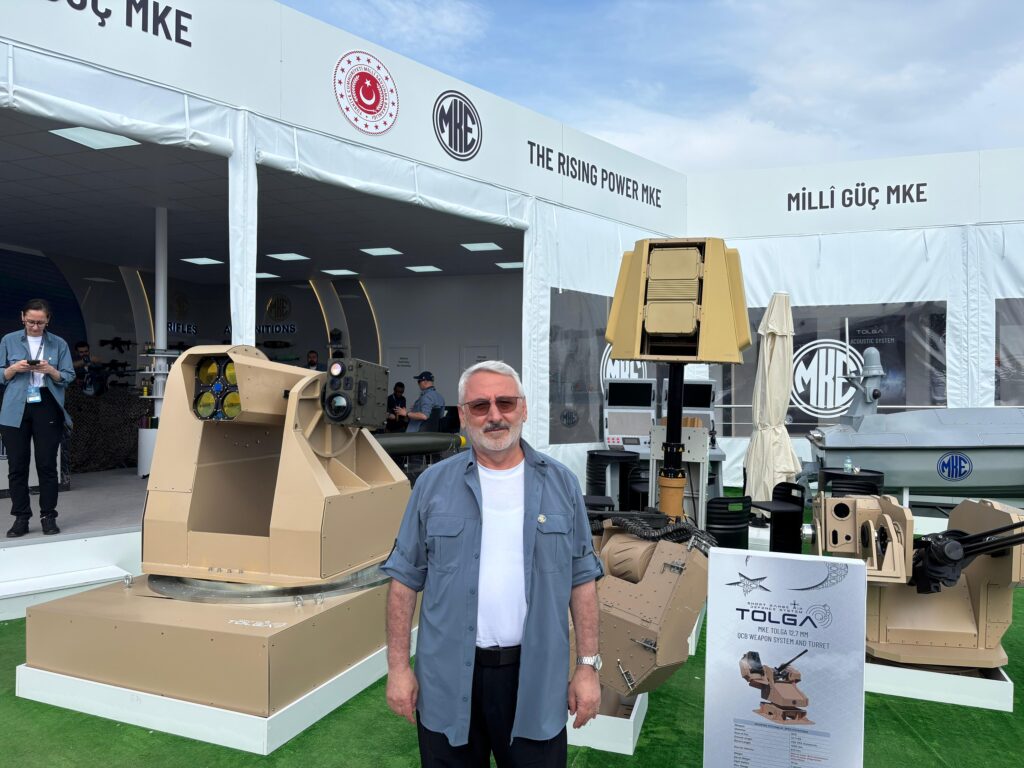
Keleş describes the exercise as his company’s “harvest season,” asserting that “every sound and every flash of light heard or seen on the exercise ground is produced by MKE.”
And when we asked him which artillery system among MKE’s “Boran,” “Yurun,” and “Attila” howitzers he considers most suitable for Arab nations, Keleş clarified that the three systems are not alternatives to one another — each is deployed according to a distinct operational context.
He explained that the Boran 105mm howitzer offers a critical advantage in mountainous and rugged terrain where vehicles cannot move swiftly, given its ability to be transported by helicopter, which grants it a high capacity for rapid repositioning. The Yurun, also a 105mm system, on the other hand gains a clear edge on flat terrain that allows vehicles to maneuver and advance with speed, according to Keleş.
On the figures, the General Manager stated that 105mm howitzers — both Boran and Yurun — reach a maximum range of 18 kilometers using extended-range ammunition, while 155mm howitzers achieve a short range of 20 kilometers and an extended range of 40 kilometers. Keleş noted that the maximum range of the 105mm caliber approaches the short range of the 155mm caliber, yet the difference remains fundamental in terms of warhead size and destructive effect on target, with 155mm rounds delivering considerably greater lethality.
We then inquired about the striking leap in the company’s exports — from roughly $40 million in 2021 to over $600 million — and how this was achieved in such a short period. Keleş attributed the surge to two principal factors.
The first, in his words, is a major expansion in production capacity and industrial output, with the company raising its production ceiling across several critical lines. The second is that a portion of the $600 million export figure stems from the sale of stockpiled ammunition that had been designated for demilitarization, which was instead redirected and marketed abroad. Keleş added, with a smile, that there is a “third factor” — the “İlhami Keleş factor” — only to confirm immediately that it was nothing more than a joke.
When we turned to him with the question of how he envisions MKE over the next five years, Keleş answered that the company is currently undergoing a comprehensive transformation across five simultaneous pillars.
The first is structural transformation: the company has completely redesigned its workflow processes, job definitions, and organizational chart, and has already transitioned to the new structure. The second is digital transformation, with MKE currently executing 36 separate digital transformation processes across different domains in parallel. The third is technological transformation, as MKE builds the infrastructure needed to develop its own proprietary technology through three tracks: establishing research centers inside Turkish universities, setting up more than one in-house R&D center, and investing in specialized technology companies that have demonstrated productivity in niche fields.
The fourth pillar is capacity investment, with Keleş disclosing an ongoing investment program valued at $1.15 billion aimed at expanding the company’s production capabilities. The fifth and final pillar is human resources transformation, with MKE now managing the selection, development, training, and specialization of its workforce according to international standards.
Defense Arabia did not miss the opportunity to ask what MKE expects from Exercise Efes and what these large-scale maneuvers represent for the company. Keleş described the exercise as “MKE’s harvest season,” noting that the company’s fingerprint is present on every weapon, platform, and round of ammunition fielded in the exercise area.
He explained that all bombs used by the Turkish Air Force in the exercise are manufactured by MKE, as are the weapons and ammunition employed by attack helicopters. At sea, the bow guns on naval vessels and their ammunition belong to MKE, as do the chaff launcher systems and their rounds. When amphibious vessels lower their ramps and infantry soldiers step onto the shore, the infantry rifles, sniper rifles, and machine guns in their hands — along with all corresponding ammunition — are MKE products. The company also provides the systems used to clear safe passages through minefields, the mortars advancing behind the first wave, and the howitzers together with their full ammunition loads.
Keleş closed with a striking remark: “Every sound and every flash of light heard or seen on the exercise ground is produced by MKE.”




Be the first to comment