
Brigadier. Salahadden Abobaker Al-Zedani Alanari
Open-source reports suggest a possible Iranian attempt to target Diego Garcia base in the Indian Ocean using medium- to intermediate-range ballistic missiles (MRBM/IRBM). Despite the absence of independent operational confirmation, the significance of this incident lies in its strategic and technical implications rather than its immediate military outcomes. This study analyzes the event in terms of the evolution of Iran’s missile capabilities, the potential shift from regional to long-range deterrence, and its impact on the balance of power and the redefinition of strategic depth.

Amid escalating regional and international tensions, open-source media and intelligence reports have emerged indicating a possible attempt to target Diego Garcia—one of the most critical joint U.S.-UK military bases in the Indian Ocean—using medium- to long-range ballistic missiles (MRBM/IRBM). The importance of this event lies in the fact that, whether it actually occurred or remained at the planning stage, it reflects a qualitative shift in Iranian strategic thinking and in the employment of missile power.
The reported attempt effectively reshaped perceptions of global military balances. The launch of two or more medium- or long-range ballistic missiles—potentially of the Khorramshahr-4 type, or another undisclosed system (given conflicting reports regarding type and number but general agreement on the event)—toward Diego Garcia was not merely a failed technical operation. Rather, it can be interpreted as a political and strategic signal indicating the emergence of Iranian missile capabilities with extended range.
Although reports suggested that the attack failed (with one missile malfunctioning and another intercepted), there remains no confirmed independent evidence verifying that an actual strike occurred. Therefore, the event must be approached cautiously, particularly as it raises concerns about escalation and the potential introduction of new weapons and operational concepts in the ongoing conflict.
From Regional to Global Deterrence
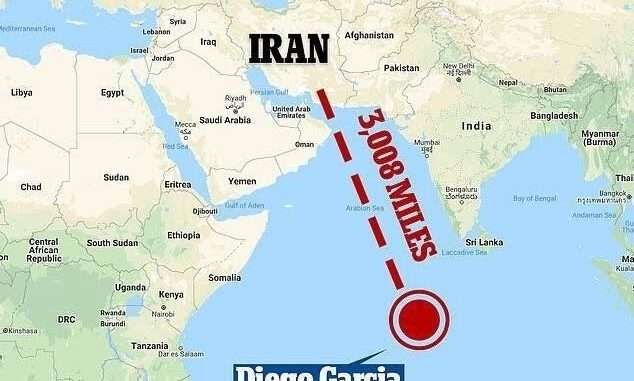
Tehran has long maintained that its missile range does not exceed 2,000 kilometers—sufficient to reach Israel and U.S. bases across the Middle East and the Gulf. However, reports regarding a potential attempt to target Diego Garcia—approximately 4,000 kilometers from Iranian territory—represent a significant leap that breaks the self-imposed operational ceiling maintained for years.
This development also diverges from U.S. defense intelligence estimates suggesting that Iran might develop intermediate or long-range missile capabilities by around 2035, should it make a political decision to do so—particularly by leveraging its space program (Simorgh), potentially with external cooperation.
The strategic implication of such an extended operational range is substantial. It suggests the capability to strike targets well beyond the Middle East, transforming distant bases from “safe havens” into potential targets. Regions such as the Indian Ocean, Central Europe, the Horn of Africa, the Gulf, the Eastern Mediterranean, and even European capitals could theoretically fall within a future Iranian target set. This also reflects the integration of space technologies into military applications through the development of multi-stage missile systems.
The Technological Leap: Hypersonic Systems
Iran’s development of hypersonic missiles represents a notable technological advancement, reflecting progress not only in propulsion and guidance systems but also in materials capable of withstanding atmospheric re-entry, as well as in payload capacity and countermeasure systems designed to evade advanced missile defense architectures.
However, despite reports suggesting the possible use of systems such as Simorgh-derived platforms or the liquid-fueled Khorramshahr-4—known for carrying heavy payloads of up to 1,500 kg with an estimated range of 2,000–3,000 km (potentially more under certain conditions)—these capabilities, while significant, do not yet constitute confirmed long-range (intermediate or intercontinental) operational systems.
Operational range maps demonstrate that extending from 2,000 km to 4,000 km is not merely a quantitative increase but a qualitative transformation in threat perception. Rear bases once considered secure would become vulnerable, fundamentally redefining the concept of strategic depth.
Some reports further suggest the possible use of two-stage missiles to reach Diego Garcia, implying that Iran may be transitioning from reliance on numerical missile saturation toward extended-range precision capabilities. This also suggests the potential conversion of space launch vehicle (SLV) technologies into long-range military applications—an issue long highlighted by Western intelligence assessments.
Technical data indicates that achieving ranges beyond 4,000 km requires either multi-stage systems or significant payload reduction. This aligns with the hypothesis of adapting SLV technologies for military purposes. According to analyses by institutions such as CSIS, Iran’s space program represents a potential technical foundation for long-range missile development, although there is still no conclusive evidence of operational intercontinental ballistic missile (ICBM) capability.
Table: Iranian Ballistic Missile Capabilities (Technical Analysis)
| Missile Name | Classification | Range (km) | Payload (kg) | Fuel Type | Accuracy (CEP) | Notes |
| Shahab-3 | MRBM | 1000–1600 | 1000 | Liquid | (Relatively Low) | Foundation of traditional deterrence |
| Ghadr-1 | MRBM | 1600–2000 | 750 | Liquid | Improved | Enhanced development |
| Emad | MRBM | ~1700 | 750 | Liquid | Higher accuracy | Improved guidance system |
| Sejjil-2 | MRBM | ~2200 | 750 | Solid | Improved | Two-stage missile |
| Khorramshahr | MRBM | 2000+ | Up to 1800 | Liquid | Moderate | Heavy payload capacity |
| Khorramshahr-4 | MRBM | ~2000 (potentially more) | 1500 | Liquid | Improved | Advanced technologies |
Why Diego Garcia?
Diego Garcia represents a cornerstone of U.S. strategic posture in the Indian Ocean. It functions as:
- A logistical and intelligence hub
- A base for long-range strategic bombers (B-52, B-2)
- A forward platform supporting operations across the Middle East, Central Asia, and East Africa
- A secure anchorage for nuclear-capable submarines
According to U.S. Department of Defense reports, it is one of the most critical hubs for long-range strike operations.
Given its central location and strategic importance since the Cold War, targeting such a base carries significant political and military implications.

Operational Scenario Analysis
In the event of a strike at a distance of approximately 4,000 km:
- Estimated flight time: 20–25 minutes
- Trajectory: Predominantly exo-atmospheric ballistic flight
- Interception phase: Likely midcourse interception using systems such as SM-3
- Key challenges:
- Accuracy (CEP)
- Maintaining effective payload
The success of such a strike would depend on:
- Targeting precision
- Ability to penetrate missile defense systems
- Integration of detection and guidance systems
Technical Comparison: Ability to Reach Diego Garcia
| System | Range Capability | Assessment |
| Shahab-3 | Insufficient | Cannot reach |
| Sejjil | Limited | Close but insufficient |
| Khorramshahr-4 | Theoretically possible | Requires payload reduction |
| Multi-stage system (space-derived) | Possible | Most plausible scenario |
Some estimates indicate that reducing payload weight may increase range, but at the expense of combat effectiveness.
Strategic Implications and Deterrence Signaling
The potential targeting of Diego Garcia carries multiple strategic dimensions:
- U.S. dimension: Possible vulnerability of operational depth
- European dimension: Inclusion within extended threat calculations
- Regional dimension: Reinforcement of deterrence balance
- Global dimension: Demonstration of emerging non-traditional deterrence capabilities
At its core, the event reflects a broader strategic message regarding Iran’s willingness to respond across extended geographic domains, combining military, psychological, and strategic signaling.
Geographic Expansion and Changing Rules of Engagement
This development suggests a potential Iranian shift from “strategic patience” to “extended-range deterrence.” Even if intercepted, the attempt itself represents a significant shift in engagement rules.
Future conflicts may no longer remain confined to the Middle East but could extend to global maritime routes and strategic bases, compelling major powers to reassess their defensive postures.
Aftermath and Strategic Assessment
The United States faces a complex deterrence dilemma: escalation risks widening the conflict, while restraint may be interpreted as weakened deterrence credibility.
Analytical indicators suggest that the significance of the Diego Garcia scenario lies not in its operational outcome, but in its strategic implications—particularly:
- Reassessment of U.S. force posture
- Strengthening missile defense systems
- Intensifying regional arms competition
- Expanding the geographic scope of confrontation
Ultimately, the event represents a shift in the concept of deterrence rather than a fully realized transformation in military capability. While Iran has not yet demonstrated operational long-range missile capability, current developments indicate movement toward extended-range systems (IRBM) and a clear trajectory toward geographically expanded deterrence.
References
- CSIS Missile Defense Project – Iran Missile Overview
- IISS Military Balance Reports
- U.S. Department of Defense – Iran Military Power Reports
- SIPRI Missile and Arms Reports
- Federation of American Scientists (FAS)
- RAND Corporation – Missile Proliferation Studies




Be the first to comment