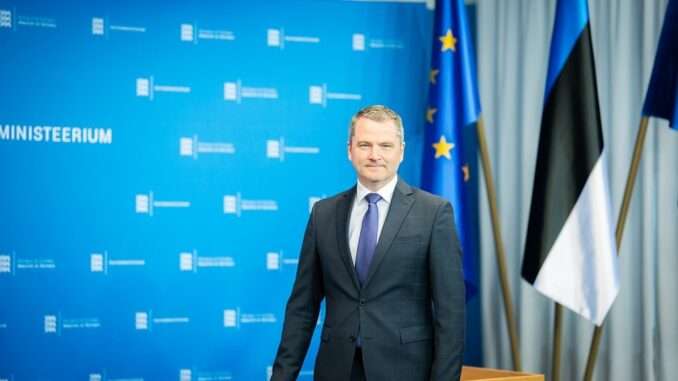
By Siim Sukles, Undersecretary for Defence Industry and Innovation, Ministry of Defence, Republic of Estonia
For much of the twentieth century, defence set the pace of technological progress. Radar, jet propulsion, satellite systems and the foundations of the internet emerged from national security requirements. Strategic urgency compressed development timelines and accelerated innovation.
After the Cold War, commercial industry assumed that role. Advances in artificial intelligence, semiconductors, cloud computing and autonomous systems were largely shaped by private capital and consumer markets. Defence adapted and integrated those capabilities.
That balance is changing one again.
Recent conflicts have shown how quickly commercially developed technologies can alter operational realities. Unmanned systems, AI-enabled analysis and resilient communications are now central to force design. Operational adaptation increasingly moves on timelines that outpace traditional multi-year procurement cycles.
Spending patterns reflect this acceleration. Worldwide military expenditure reached $2.44 trillion in 2023 (SIPRI, Trends in World Military Expenditure 2023, 2024). Investment in unmanned and autonomous systems continues to expand across major defence markets, reflecting the growing centrality of these capabilities in modern force design.
The Middle East is playing an increasingly prominent role in this development. Regional military expenditure rose by 9 percent in 2023 to approximately $200 billion (SIPRI, 2024), alongside sustained investment in air defence, autonomous platforms and domestic industrial capability. Several Gulf states are embedding localisation and technology transfer into major procurement programmes, linking acquisition to long-term industrial development.
Expenditure alone, however, is not decisive. The critical constraint is often time: the interval between identifying a requirement and deploying a credible capability.
Across many defence ecosystems, promising technologies do not progress beyond prototype because alignment between operational need, procurement pathways and industrial development remains incomplete. Bridging that gap requires institutional clarity, disciplined processes and sustained cooperation between government, armed forces and industry.
In Estonia, defence is the fastest-growing sector of our economy. Our objective is not growth in isolation, but usable capability. Clear threat assessment informs well-defined capability requirements. Industry and research partners are encouraged to pursue ambitious solutions that respond directly to operational need.
This emphasis on deployable capability is reflected across Estonia’s defence industry. DefSecIntel Solutions, which participated in World Defense Show, develops surveillance and counter-UAS systems through structured collaboration with defence forces and live testing environments. In parallel, 5.0 Robotics is advancing portable manufacturing systems that enable components to be produced closer to the point of need, strengthening sustainment and reducing reliance on centralised production infrastructure. These are just two examples of Estonia’s high-quality defence products that illustrate how institutional alignment translates into practical capability rather than isolated technological demonstration.
Innovation at pace requires acceptance of risk. If every project succeeds without adjustment, the ambition was likely insufficient. Structured experimentation, combined with rigorous evaluation, shortens the distance between concept and capability.
To reduce delay, Estonia has introduced procedures designed to move from identifying a requirement to initiating procurement within one year. For example, we have established a Defence Forces’ Future Capabilities and Innovation Command to connect operational units, academia and industry through continuous testing and feedback. Alongside this, major military exercises provide live validation environments, ensuring that systems are assessed under realistic conditions and refined accordingly.
Operational maturity is critical because defence customers require systems that work in real conditions, not just in controlled demonstrations. Reliability, rapid integration and sustainable support reduce operational risk and accelerate deployment timelines. Estonia offers major international defence contractors highly specialised technical capability combined with the agility of a compact innovation ecosystem. Because of this, our companies are able to develop and refine advanced systems quickly, particularly in software-driven and digitally integrated domains.
Defence is again operating close to the technological frontier. Autonomous platforms, advanced sensing and AI-supported decision-making are changing the character of military capability. History suggests that in such periods, security requirements exert a strong pull on technological development. The institutions that align capability needs, industrial capacity and procurement tempo will influence where that development leads. In Estonia, we understand this — and we are firmly on course.




Be the first to comment