
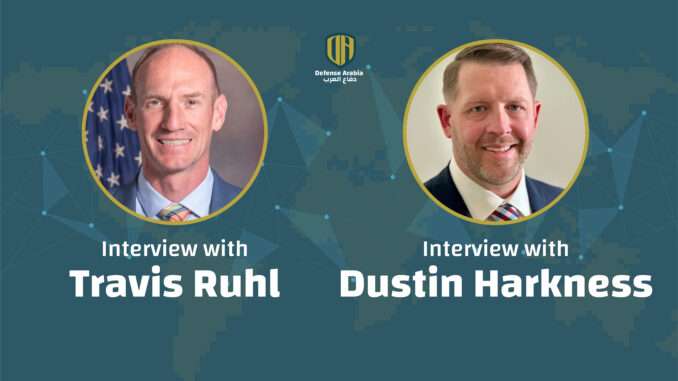
As modern battlefields become increasingly saturated with advanced air defenses, electronic warfare systems, and proliferated drone threats, survivability and spectrum dominance have never been more critical. In this exclusive interview, Defense Arabia speaks with Travis “Posum” Ruhl, retired F-16 pilot and Viper Shield Electronic Warfare Lead at L3Harris, alongside a Dustin Harkness Principal of Business Development for Domestic Counter UAS، on the company’s counter-unmanned aerial systems portfolio.
From the digital transformation of F-16 electronic warfare through Viper Shield to the evolving counter-drone battlefield shaped by VAMPIRE, the discussion explores how next-generation electronic protection and modular C-UAS solutions are redefining tactical advantage.
Viper Shield: The Digital Shield for F-16 Fighters
Q: What makes the Viper Shield Electronic Warfare (EW) system stand out as a low-risk, high-performance option for F-16 fighters?
Travis “Posum” Ruhl: We have been on a long development journey with this system, and we are very proud to have reached the actual production stage. Building EW systems requires significant time and effort; reaching the end of that developmental path is what provides the customer with a “low-risk option.”
Regarding high performance, the system was designed from the outset to be fully digital (3U VPX), utilizing Digital Radio Frequency Memory (DRFM) response with a wideband staring receiver. This allows the system to see the entire frequency spectrum and respond digitally to modern, agile threats.
Excellence in Complex Combat Environments
Q: How does Viper Shield enhance the survivability of F-16s in high-intensity electronic warfare environments?
Travis “Posum” Ruhl: As a former F-16 pilot, this is the EW system I would have wanted on my jet. Its excellence lies in “full automation”; the system responds to threats at the lightning pace of today’s battlefield. This is vital for countering modern threats that may only appear for a single pulse.
The system provides what we call “digital armor” for the aircraft, with a superior capability for continuous software and firmware updates to meet evolving threats, ensuring pilots return home safely.
Flexibility Between Internal Systems and Pods
Q: What advantages do customers gain from having Viper Shield available in both internal (integrated) and external (podded) configurations?
Travis “Posum” Ruhl: The internal system features deep integration with the aircraft’s radar and avionics while reducing fuel consumption. The podded version uses the exact same hardware, allowing for parts commonality between the two.
The major advantage of the pods is “plug-and-play” capability for aircraft undergoing “V-configuration” upgrades. This offers significant cost savings for nations, as they do not need to purchase a system for every single aircraft. Instead, they can buy a quantity of systems equivalent to roughly 50% of the fleet and rotate them between aircraft based on operational needs.
VAMPIRE: The Optimal Solution for Countering Drones
Q: What distinguishes L3Harris’s capabilities in the field of Counter-Unmanned Aerial Systems (C-UAS)?
Dustin Harkness: Our system is “vehicle agnostic,” giving the end-user flexibility in choosing the platform—whether it is vehicle-based, palletized, containerized, or even for maritime environments.
It is also designed to be “MOS agnostic,” meaning you do not necessarily need to be an air defense professional to operate it. The “WIDOW” mission management software features an extremely intuitive user interface, making the learning curve very shallow.
Addressing Group 2 and 3 Drone Threats
Q: How does the VAMPIRE system adapt to low-cost drone threats and swarms?
Dustin Harkness: The VAMPIRE system particularly excels against Group 2 and 3 drones—such as the Shahed-136 and Orlan—using rocket-based effectors as a primary interception tool. As part of our product roadmap, we are introducing additional effectors, including electronic warfare and gun-based systems, to address other categories of threats.
Integration with Existing Command and Control Systems
Q: How is the counter-drone system integrated with pre-existing fire control networks?
Dustin Harkness: Through the WIDOW mission management software, we can perform a relatively simple integration to operate as either fully integrated or interoperable with existing Command and Control (C2) and fire control networks. We have proven the success of this integration in various regions worldwide, and we are currently working to build on these successes within this region.




Be the first to comment