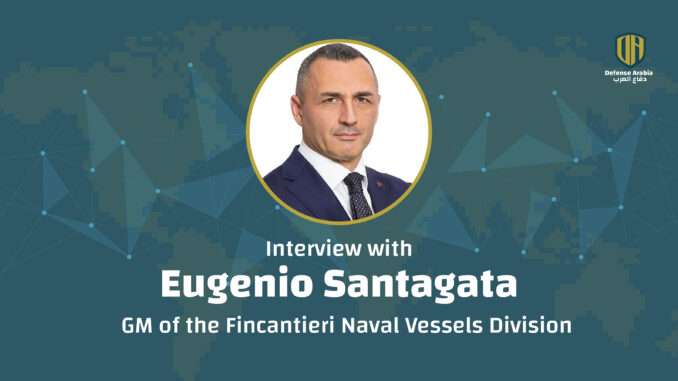
At World Defense Show 2026, Defense Arabia sat down with Eugenio Santagata, General Manager of the Naval Vessels Division at Fincantieri, to discuss the company’s expanding strategic footprint in Saudi Arabia and its long-term vision for maritime security cooperation in the region.
The conversation explored the significance of Fincantieri’s €200 million MU90 torpedo contract with the Saudi Ministry of Defense, the operational advantages of the FREMM EVO frigate, and the company’s approach to strengthening naval capabilities through advanced surface and underwater technologies. Santagata also addressed the growing importance of subsea infrastructure protection, industrial localization, and technology transfer, outlining how Fincantieri aims to evolve from a traditional supplier into a strategic partner supporting the Kingdom’s maritime ambitions under Vision 2030.
You just signed a major €200 million deal for MU90 torpedoes. Does this direct contract with the Ministry change how Fincantieri operates in the Kingdom moving forward?
- The recent contract for the MU90 torpedoes represents far more than a commercial achievement. It is a strategic confirmation of the trajectory we have been building in Saudi Arabia: a long‑term, structured presence aligned with the development priorities of Vision 2030.
- This result strengthens our industrial footprint in the Kingdom and reflects our commitment to an integrated, end-to-end approach, where advanced technologies, industrial cooperation, and local capabilities evolve together.
- Following the establishment of Fincantieri Arabia for Naval Services in 2024, this milestone consolidates our long‑term commitment: working consistently to support the Kingdom in building a strong, self‑sufficient maritime ecosystem that spans from high‑tech solutions to industrial localization and workforce development.
You are showcasing the FREMM EVO here. How does this specific ship fit the current needs of the Royal Saudi Naval Forces compared to larger frigates?
- Saudi Arabia has clearly set the enhancement of its naval capabilities as a national priority, and this strategic direction is the reference point for how we look at all our platforms.
- FREMM EVO is a mature, interoperable, and scalable platform that aligns very closely with Saudi defense priorities and that fully meets the operational needs of the Royal Saudi Naval Forces. These vessels, which stem from the original and well-proven FREMM program, will be at the forefront of defense vessels, both in terms of technology and performance, building on the main technological developments already achieved in recent programs and further improving capabilities through the integration of the latest anti-drone and unmanned systems across three domains. The FREMM EVO represents the cornerstone of the Italian Navy’s fleet, with Fincantieri currently building the two new “evolution” frigates at its Italian shipyards.
- Thanks to its modular design and structured upgrade roadmap, FREMM EVO provides an effective platform for local industry engagement, capability development, and supply‑chain expansion, fully aligned with Vision 2030 and supportive of the long‑term industrial and technological ecosystem we are shaping together.
Security in the Red Sea is a critical topic. Are you in talks to bring your underwater drones or the SAND surface vessels to help protect Saudi infrastructure?
- Security at sea today demands an integrated approach that combines surface presence with deep‑domain awareness and resilience. A core pillar of our strategy is the underwater domain, where we are consolidating our position as a leading technological innovator in the protection of subsea infrastructure and in the development of dual‑use unmanned capabilities.
- The growing dependence on submarine cables, energy interconnections, and port ecosystems—together with evolving geopolitical dynamics—has made the security of underwater assets central to both economic stability and national defense. Interest in submarine domain and infrastructure protection is acknowledged as a medium‑to‑long‑term trajectory, fully embedded in a balanced force‑development path.
- From a capability standpoint, we are proposing the DEEP system: a comprehensive system‑of‑systems that integrates underwater autonomous vehicles, surface and uncrewed platforms, and advanced command‑and‑control. It is designed to deliver persistent seabed awareness, infrastructure monitoring, and rapid intervention, with seamless applicability across both military and civilian missions, including the protection of critical port and coastal infrastructure.
- This is a particularly critical issue in complex operating environments. The Red Sea, for example, as a vital artery for global trade and energy flows, illustrates where these capabilities are most relevant—not only in enhancing naval operations, but in safeguarding critical infrastructure at scale.
How deep is your partnership with local companies like SAMI? Are you ready to transfer sensitive technology, specifically for underwater combat systems?
- In Saudi Arabia, our focus is on supporting and enabling local entities across the entire maritime domain. This translates into developing local capabilities and laying the foundations for a sustainable industrial ecosystem that can meet national requirements and support the needs of the wider region. In other words, our ambition is not simply to deliver platforms or systems, but to help build an enduring maritime industrial base.
- This strategic intent is already visible in concrete initiatives with local institutions and entities. We have secured a major contract from the Saudi Ministry of Defense for the supply of MU90 lightweight torpedoes, demonstrating operational trust and industrial engagement. Complementing this, in 2025 we signed an agreement with the Ministry of Industry and Mineral Resources to advance an integrated, sustainable, high‑tech maritime ecosystem aligned with Vision 2030. At the same time, our partnership with King Abdullah University of Science and Technology (KAUST) supports young Saudi researchers in maritime security, cyber resilience, and navigation technologies, thereby reinforcing the knowledge base that underpins future capabilities.
- Against this backdrop, when it comes to sensitive technologies, including underwater combat systems, our approach is pragmatic, responsible, and structured. Technology transfer is therefore conceived as a phased process, ensuring sustainability and operational effectiveness over time.
- Taken together, these efforts reflect our readiness to support the Kingdom’s ambitions by building capability, competence, and technological sovereignty progressively and securely, in full consistency with Vision 2030.
Looking at Vision 2030, what is your main target for the next five years? Do you aim to remain a hardware supplier or become a full strategic partner for the Saudi Navy’s industrial base?
- We have no ambition to remain solely a supplier. Our goal, fully aligned with Vision 2030, is to act as a strategic industrial partner, contributing to the Kingdom’s long‑term objectives in naval, technological, and industrial sovereignty.
With this trajectory, we are not just building ships: we are building robust, future‑oriented industrial relationships, designed to grow with the Kingdom’s ambitions.




Be the first to comment