
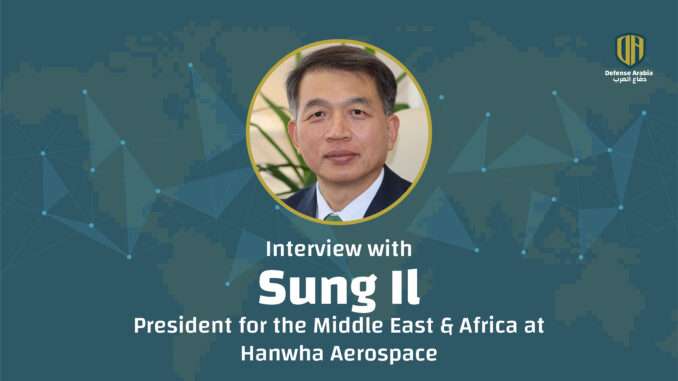
Defense Arabia had the privilege of conducting an exclusive interview with Mr. Sung Il, President for the Middle East and Africa at Hanwha Aerospace, on the occasion of the official launch of the company’s new Regional Headquarters in Riyadh. This strategic move marks a major milestone in Hanwha Aerospace’s expansion into the Middle East and North Africa, positioning Saudi Arabia at the center of its long-term vision for defense cooperation, localization, and industrial partnerships.
In this interview, Mr. Sung Il shares insights into the strategic importance of the Riyadh RHQ, its alignment with Saudi Arabia’s Vision 2030, and Hanwha’s plans to deliver advanced defense solutions, foster technology transfer, and build sustainable partnerships across the region. He also explains how Hanwha intends to balance global competitiveness with deep localization, and why the company sees itself not only as a defense supplier, but as a trusted, long-term partner for the Kingdom and the wider MENA region.
Q1. What is the strategic significance of establishing the RHQ?
A1. The Riyadh RHQ elevates Hanwha Aerospace from being a supplier to becoming a long-term strategic partner in the Middle East. It serves as a command and coordination platform to integrate partnerships, accelerate industrial cooperation, and directly support defense modernization across MENA. At the same time, it anchors the region within Hanwha’s global R&D, production, and supply networks, making the Middle East an integral part of our global strategy.
Q2. Why was the RHQ established in Saudi Arabia?
A2. Saudi Arabia is the geopolitical center of the Middle East and a critical connector to GCC states and global supply chains. The Kingdom is advancing both defense modernization and industrial diversification, spearheaded by Vision 2030. As a regional leader in security and defense cooperation, Saudi Arabia is the optimal location for our RHQ. From Riyadh, we will anchor our partnerships and expand cooperation across the wider MENA region.
Q3. How does the RHQ align with Saudi Arabia’s Vision 2030?
A3. Vision 2030 emphasizes industrial diversification, technological self-reliance, and job creation. Hanwha supports this vision by investing in local production, technology transfer, MRO facilities, and training programs. This contributes not only to Saudi Arabia’s defense capability but also to the broader development of its industrial base and sustainable economic growth.

Q4. What key capabilities will Hanwha bring to the region?
A4. Hanwha offers a full-spectrum portfolio spanning land, sea, air, and space. In the Middle East, we are focusing not only on ground systems such as the K9 self-propelled howitzer (combat-proven firepower and mobility) and the Tigon armored vehicle (multi-role capability), but also on advanced integrated air defense systems including M-SAM and L-SAM, radars, and precision-guided munitions. Beyond this, we are ready to collaborate in aerospace domains such as satellite systems, space launch vehicles, and avionics. In addition, Hanwha Group’s diversified businesses in energy, chemicals, materials, and finance enable us to provide broader industrial capabilities and partnership opportunities. This allows us to contribute not only to regional security and defense self-reliance, but also to long-term economic development and sustainable growth in the region.
Q5. How important is localization and industrial cooperation in your strategy?
A5. Localization is at the core of Hanwha’s global strategy. In Australia, we have established a local factory; in Poland, we are executing large-scale defense programs through strong local partnerships; and in Romania, we are preparing to invest in future localization initiatives. Building on this track record, we will apply the same model in Saudi Arabia and across the Middle East—enhancing supply chain resilience, ensuring technology transfer, and creating jobs, thereby fostering sustainable co-growth.
Q6. How does the RHQ fit within Hanwha’s global defense strategy?
A6. Hanwha Aerospace is a core affiliate of Hanwha Group, a Fortune Global 500 company, executing a multi-domestic strategy worldwide. The Riyadh RHQ integrates the Middle East into our global network alongside Europe, Asia-Pacific, and North America. This ensures that Saudi Arabia and MENA have direct access to Hanwha’s R&D, production, and supply chains.

Q7. What are Hanwha’s future plans for the Middle East?
A7. Our vision is to be a trusted long-term partner for the region. We will pursue joint R&D, training, and expanded industrial participation, while also broadening cooperation beyond defense into energy transition, advanced materials, and space. The RHQ will function as the central hub to coordinate all these strategic initiatives.
Q8. Why Hanwha? What makes Hanwha a distinct and reliable partner?
A8. Hanwha Group is a Fortune Global 500 company and South Korea’s 7th largest conglomerate, with a diversified industrial ecosystem spanning defense, energy, materials, and finance. Hanwha Aerospace, as the group’s flagship defense company, provides advanced solutions across land, sea, air, and space. Our proven track record of localization in global markets such as Australia, Poland, Romania, and the United States demonstrates that we are not just a supplier, but a long-term strategic partner. Hanwha offers a unique combination of technological expertise, industrial cooperation capability, and financial stability—qualities that make us a distinct and reliable partner.

Q9. How does Hanwha plan to balance technology transfer with maintaining competitiveness, given the presence of strong global competitors?
A9. Technology transfer is more than simply handing over documents. It is built through accumulated experience, trial and error, and sharing practical know-how. Unlike other countries that are often reluctant to share advanced technologies, Korea has developed strong indigenous capabilities.
Our objective is to gradually build Saudi Arabia’s capabilities by starting at a foundational level and expanding into more advanced cooperation over time. The ultimate goal is for the Kingdom to gain its own technological expertise and self-reliance, supported by Hanwha’s experience.

Q10. Saudi Arabia employs a diverse mix of air defense systems from China, Europe, and the United States. How does Hanwha’s technology fit into this environment?
A10. This is an important question. In Korea, our own air defense forces operate American, French, and Korean systems simultaneously. We have developed the ability to integrate these different platforms into one cohesive system.
Hanwha provides solutions that allow various systems, whether American PAC-3, Korean M-SAM and L-SAM, or European systems, to be interconnected and operated as one integrated network. This capability is one of the most valuable solutions we can offer to Saudi Arabia.

Q11. Will Hanwha adapt its products specifically to Middle Eastern conditions, or will they remain as they are designed in Korea?
A11. Technically, we already test and operate our systems under a wide range of conditions, from harsh Arctic climates to extreme heat. We understand the challenges posed by the Middle Eastern environment, and we are confident that our products can be adapted and optimized to meet those requirements.
In short, yes, our systems are fully tested, and we are committed to ensuring they perform reliably in the Kingdom’s demanding conditions.



Be the first to comment