
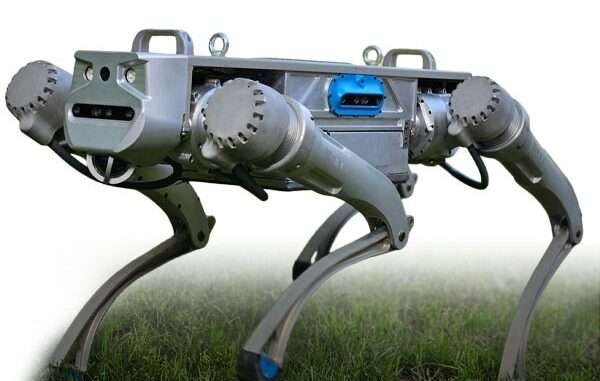
VITEC’s ruggedized, ultra‑low latency video encoding technology has been deployed in Hyperever’s Proteo quadruped robot to establish a mission‑ready live video platform. The ‘robodog’ serves as a forward reconnaissance asset, delivering secure, broadcast‑quality streams from the field to command and control systems. The video solution incorporates MGW Pico+ TOUGH and MGW Diamond TOUGH encoders to enable real‑time situational awareness, efficient bandwidth usage and seamless integration with existing intelligence, surveillance and reconnaissance (ISR) architectures.
As uncrewed ground systems take on increasingly complex roles in defense, security and critical infrastructure operations, the ability to stream high‑quality video in real time has become crucial. Hyperever’s Proteo quadruped robodog is designed to operate in complex and demanding environments, supporting applications ranging from ISR and explosive ordinance disposal to remote tactical operations.
Hyperever required a video solution capable of delivering secure, broadcast‑quality imagery with ultra‑low latency, even in constrained or contested network environments. Proteo is engineered to traverse difficult terrain autonomously or semi‑autonomously, carrying payloads of up to approximately 35kg, operating for up to six hours and reaching speeds of around 12 km/h. While the platform’s mobility and payload capabilities were well established, conventional video payloads presented limitations. Higher latency streams, inefficient compression and integration challenges with tactical command and control (C2) networks reduced the effectiveness of video as a real‑time decision‑making tool.
For field commanders and operators, particularly in high‑risk or time‑critical scenarios, video latency can directly impact situational awareness and sensor‑to‑decision time. Hyperever therefore required a compact, ruggedized encoder with a low SWaP profile, capable of securely streaming high‑quality video and metadata from the robodog directly into existing ISR and C2 architectures.
By integrating VITEC’s MGW Pico+ TOUGH and MGW Diamond TOUGH encoders as part of Proteo’s payload, Hyperever enabled the robodog to act as a tactical video streaming video node, delivering secure full motion video directly from deployed assets to command centers and field operatives. The hardware‑based encoders support HEVC and H.264 compression, allowing high‑quality HD and 4K video to be transmitted efficiently over tactical networks.
Designed to meet the demands of military and security deployments, the encoders provide MIL‑spec ruggedization, ultra‑low latency performance and support for standard protocols and metadata, including KLV and STANAG processing. This ensures seamless interoperability with existing systems, while overlays for video identification and timestamping further enhance operational usability.
The integration of VITEC’s video technology has significantly expanded the operational value of the Proteo robodog. Rather than functioning solely as a mobile robotic platform, Proteo now delivers broadcast‑quality live video and metadata to C2 nodes in near real time, supporting faster and more informed decision‑making.
Ultra‑low latency encoding reduces delays compared with standard video payloads, while HEVC compression delivers up to approximately 50% bandwidth savings, enabling reliable streaming even in bandwidth‑constrained environments. The use of standard protocols ensures straightforward integration into existing ISR infrastructures, with decoding available on both fixed and mobile devices.
“VITEC has decades of experience delivering reliable, low‑latency video in the most demanding environments, and this project demonstrates how that expertise translates to autonomous robotics,” shares Ghassan Dadokh, Senior Business Development Manager (Security & Defense), VITEC. “Proteo becomes far more than a mobile platform when it can stream secure, high‑quality video and metadata directly into existing ISR architectures, turning the robodog into a true forward reconnaissance node.”




Be the first to comment