
Von Neumann recognized decades ago that the most dangerous games are the ones players believe they cannot afford to lose.

Dr. Najwa Aaraj
The modern battlespace is no longer defined solely by territory, tanks, or troop formations. It is increasingly governed by algorithms, autonomous systems, machine-speed decision cycles, and strategic interactions that resemble the mathematical models first explored by John von Neumann. In the twenty-first century, conflict is becoming less a contest of armies and morea contest of adaptive systems.
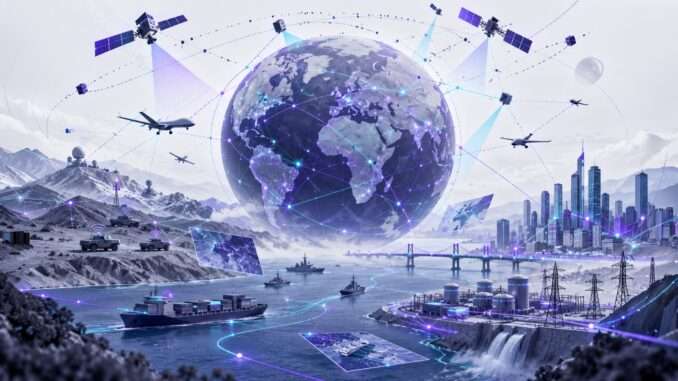
More critically, modern warfare is evolving into what defense theorists increasingly describe as system-of-systems conflict: the integration of military, economic, cyber, space, industrial, informational, financial, and societal networks into a single operational ecosystem. Victory no longer depends solely on destroying opposing forces. It depends on disrupting, degrading, or destabilizing the interconnected systems that sustain an adversary’s ability to operate, adapt, decide, recover, and preserve sovereign autonomy under pressure.
This transformation is redefining sovereignty itself. The central argument of this essay is that sovereignty is no longer primarily territorial but systemic: a function of a state’s control over the data, computation, networks, and industrial capacity on which its autonomy now depends.
For centuries, sovereignty was primarily territorial: the ability of a state to control borders, populations, resources, and the legitimate use of force within a defined geography. Today, sovereignty increasingly depends on control over data, computation, semiconductors, energy systems, cloud infrastructure, satellite networks, digital communications, AI architectures, and supply chains. A nation may retain formal territorial sovereignty while steadily losing functional sovereignty if its critical systems depend on vulnerable or externally controlled technological ecosystems.
Modern sovereignty is therefore becoming systemic rather than purely territorial. The strategic question is no longer simply whether a state can defend its borders, but whether it can maintain independent decision-making capability during persistent technological disruption. Cyber sovereignty, industrial sovereignty, algorithmic sovereignty, energy sovereignty, financial sovereignty, and space sovereignty are becoming inseparable from national defense.
Von Neumann’s foundational insight, set out in Theory of Games and Economic Behavior (1944), was deceptively simple: rational actors operating under pressure will often make decisions that produce collectively destructive outcomes, even when all participants understand the risks. That logic now sits at the center of modern geopolitical confrontation. Contemporary strategic competition increasingly resembles a multiplayer, persistent game in which states, proxy actors, autonomous agents, cyber units, AI-enabled systems, insurgent networks, and economic actors all interact simultaneously in a dynamic environment of incomplete information and continuous escalation.
Traditional deterrence theory assumed that actors moved slowly enough for diplomacy to interrupt escalation. That assumption is rapidly eroding. Advanced military technologies have compressed decision timelines from days and hours into minutes and seconds. Artificial intelligence systems now assist in target recognition, missile defense coordination, cyber intrusion detection, electronic warfare management, and predictive operational planning. Autonomous drones can swarm independently. Machine-learning models can identify vulnerabilities faster than human analysts. Cyber weapons can silently degrade infrastructure long before kinetic conflict begins.
In this environment, strategic interaction increasingly resembles what game theorists call an N-player dilemma: a system where no participant can fully control escalation because too many semi-autonomous actors are simultaneously optimizing for tactical advantage. The result is not stable victory, but unstable equilibrium.
This dynamic is especially dangerous in confrontations between technologically advanced coalitions and revisionist regional powers pursuing asymmetric strategies. In such contests, weaker actors rarely seek conventional parity. Instead, they exploit distributed networks, cyber disruption, information warfare, autonomous systems, proxy forces, insurgent ecosystems, and strategic ambiguity to raise the cost of engagement for superior powers. The objective is not necessarily battlefield dominance. It is systems exhaustion. The pattern is structurally consistent: when a weaker actor fields large numbers of low-cost, dispersed, and difficult-to-attribute systems, it can compel a technologically superior adversary into sustained and disproportionately expensive defensive operations, steadily eroding the economic and political tolerance required to maintain a prolonged response.
A technologically superior coalition may dominate in conventional airpower, intelligence fusion, precision targeting, and space-based surveillance. Yet game theory suggests that dominance alone does not guarantee strategic success. If the weaker actor can create enough uncertainty, increase enough economic friction, and sustain enough distributed disruption, it alters the payoff matrix itself. A weaker player can transform military inferiority into strategic resilience by forcing stronger adversaries into a prolonged cycle of high-cost response operations.
Deterrence itself is no longer purely nuclear, kinetic, or territorial. Modern deterrence increasingly operates as a layered architecture integrating cyber resilience, AI-enabled early warning, electronic warfare dominance, space-based sensing, missile defense, autonomous interception systems, directed-energy weapons, industrial redundancy, and cognitive influence operations. Strategic defense is evolving from static protection into adaptive resilience: the ability of an entire national system to absorb disruption, maintain operational continuity, preserve sovereign decision-making, and rapidly reconstitute capability under persistent attack.
The battlefield is no longer linear. It is layered across domains:
• AI-enabled cyber operations targeting critical infrastructure, alongside electronic warfare against communications and navigation and space-based ISR and satellite interference — a single layer of multi-spectrum disruption
• Directed-energy platforms designed to neutralize drones and missiles
• Autonomous maritime systems threatening trade corridors
• Deepfake-driven information campaigns manipulating public perception
• Algorithmic financial warfare targeting markets and supply chains
• Swarming robotics overwhelming traditional defensive architectures
• Supply-chain coercion targeting industrial and technological dependencies
Each layer interacts with the others, creating a strategic ecosystem where escalation becomes increasingly difficult to predict.
Von Neumann understood that rational actors trapped in competitive systems often escalate because standing still appears more dangerous than moving forward. In modern technological conflict, AI accelerates this logic dramatically. Machine-speed warfare incentivizes preemption. Predictive analytics encourage anticipatory strikes. Autonomous systems reduce the political cost of tactical aggression. Cyber operations blur the line between peace and war.
The danger is not merely escalation. The danger is automated escalation.
Agentic AI frameworks are systems capable of independently planning and executing multi-step objectives. They are beginning to transform military command structures. Future operational environments may involve semi-autonomous and autonomous decision ecosystems where human oversight becomes increasingly abstract. AI agents will coordinate drone swarms, conduct cyber reconnaissance, optimize EW frequencies, reroute logistics, prioritize targeting recommendations, manage integrated air and missile defense networks, and dynamically synchronize multi-domain operations faster than human operators can verify them.
In theory, this creates overwhelming strategic efficiency.
In practice, it may create what von Neumann feared most: a game in which every participant is compelled toward escalation because the cost of hesitation exceeds the cost of action.
The classic Prisoner’s Dilemma helps explain why technologically advanced conflicts become so difficult to contain. Two adversaries may both understand that restraint is collectively beneficial. Yet neither can trust the other to remain restrained once autonomous systems, cyber vulnerabilities, and strategic deterrence are involved. The rational response becomes escalation readiness.
What machine speed changes is the structure of the payoffs themselves. In the classical formulation the dilemma is static: each player chooses once, simultaneously, against fixed costs and benefits. Autonomous and AI-enabled systems make the game continuous and compress the decision interval toward zero. As the time available to verify an adversary’s intent shrinks, the expected cost of waiting rises relative to the expected cost of acting, and the equilibrium shifts toward preemption. The dilemma is no longer simply whether to defect, but whether an actor can afford the seconds required to confirm that the other side has not already done so. In an N-player environment, where each participant is running the same calculation about every other, that compression makes a stable cooperative equilibrium structurally harder to reach.
Consider directed-energy systems. Their tactical promise is enormous: low-cost interception of drones, missiles, and electronic threats at the speed of light. But their strategic implication is even larger. If defensive systems become cheap, scalable, and autonomous, offensive actors respond by increasing volume, dispersion, and unpredictability. The competition shifts from precision warfare to systems saturation.
The same cycle applies to cyber warfare.
As AI improves defensive cybersecurity, offensive cyber actors increasingly rely on adaptive malware, autonomous penetration testing, synthetic identity generation, and AI-assisted reconnaissance. The battlefield becomes recursive: machines countering machines inside continuously evolving digital ecosystems.
Electronic warfare follows the same pattern. Once communications become resilient, adversaries attack GPS reliability, spectrum access, satellite dependencies, navigation algorithms, sensor fusion, and data integrity itself. Victory no longer depends on destroying platforms. It depends on degrading decision quality.
That may ultimately define twenty-first century conflict: the struggle to corrupt an opponent’s decision architecture faster than they can corrupt yours.
This transformation also reshapes counterinsurgency.
Traditional counterinsurgency focused on territory, population control, and political legitimacy. Modern technologically enabled insurgencies operate differently. They function as decentralized adaptive networks leveraging encrypted communications, autonomous drones, cyber sabotage, AI-generated propaganda, cryptocurrency financing, and distributed influence operations. Insurgency is no longer confined to rural sanctuaries or urban guerrilla warfare. It now exists simultaneously across physical, digital, financial, and cognitive domains. Such movements increasingly fuse externally supplied autonomous systems, encrypted command-and-control, and decentralized digital financing into a single adaptive network, completing the transition from geographically bounded insurgency to a distributed, multi-domain form.
As a result, counterinsurgency itself is becoming an integrated, cross-domain challenge requiring integrated surveillance architectures, AI-enabled intelligence fusion, predictive analytics, autonomous ISR platforms, cyber defense, and real-time information operations. The distinction between military operations, homeland security, cyber defense, economic resilience, and sovereign infrastructure protection is steadily collapsing.
Modern technological conflicts increasingly blur the boundary between civilian and military infrastructure. AI systems depend on cloud architecture, semiconductors, electronic systems and subsystems, energy grids, satellite networks, rare earth supply chains, and undersea cables. Economic resilience becomes inseparable from national security. Supply chains become strategic terrain. Data becomes both weapon and target.
This creates a paradox central to modern game theory: the more technologically interconnected advanced societies become, the more vulnerable they become to asymmetric disruption.
A weaker adversary no longer needs to defeat a stronger coalition conventionally. It only needs to create sufficient friction inside interconnected systems to generate political fatigue, economic instability, societal polarization, technological dependency, or strategic hesitation.
In this environment, sovereignty itself becomes vulnerable to erosion without invasion.
A nation can lose strategic autonomy not through occupation, but through dependency. A state unable to secure semiconductor access, defend its digital infrastructure, protect its data architecture, maintain industrial production, or preserve trusted information environments may find its sovereign decision-making constrained by external technological leverage. Future geopolitical competition will therefore revolve not only around military power, but around who controls the infrastructures upon which modern sovereignty depends.
That is why future conflicts may not end with decisive victories. They may instead settle into what game theorists describe as degraded equilibria: situations where no actor achieves its strategic objectives, yet all participants incur escalating costs while systemic resilience steadily deteriorates.
Emerging conflicts operate through distributed networks of states, proxies, cyber actors, autonomous systems, insurgent ecosystems, and AI-enhanced military architectures. The number of decision nodes has multiplied dramatically. So has the speed of interaction.
The result is an environment where strategic miscalculation becomes not an anomaly, but a structural feature.
Yet there is another possibility embedded within game theory itself.
Iterated games, repeated interactions over time, sometimes produce cooperative equilibria even among rivals. Stable deterrence can emerge when actors recognize that unchecked escalation damages all participants.
The challenge for modern policymakers is whether human institutions can adapt quickly enough to govern machine-speed conflict before autonomous escalation dynamics outpace diplomacy itself.
The future of warfare may therefore hinge less on who possesses the most advanced weapons and more on who best understands the mathematics of strategic interaction inside interconnected systems operating in an AI-driven world, and who can preserve sovereignty within them.
For policymakers, three priorities follow. First, sustained investment in technological sovereignty across the AI, semiconductor, and post-quantum cryptography stack, so that critical decision systems are not externally dependent. Second, the rapid maturation of human-in-the-loop standards governing autonomous and agentic systems, before machine-speed escalation outpaces human deliberation. Third, the construction of allied resilience architectures designed to absorb systemic disruption, not merely to deter it. Each requires institutional adaptation faster than the technologies themselves are evolving.
Von Neumann recognized decades ago that the most dangerous games are the ones players believe they cannot afford to lose.
Today, advanced technology is ensuring those games never truly stop.


Be the first to comment