
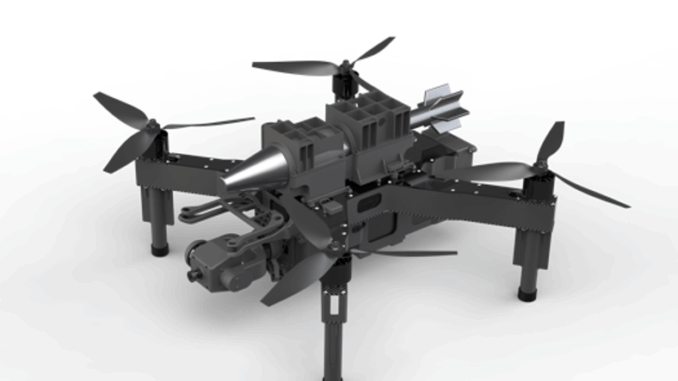
As small autonomous drones reshape modern battlefields, militaries are increasingly exploring swarm-based systems that combine reconnaissance, coordination, and precision strike capabilities. One such system is XAiDEN, a modular swarming loitering munition cluster designed to enable coordinated swarm operations while maintaining human oversight.
Autonomous Drone Architecture
At its core, XAiDEN operates as a ten-unit drone cluster composed of one Commander drone and nine Striker drones. The Commander performs reconnaissance and coordination using EO/IR sensors, while the Strikers function as loitering munition units, executing engagement tasks once assigned. This structure reflects a familiar military principle: centralized intent with decentralized execution, allowing the swarm to maintain mission continuity even if communications are disrupted.
Importantly, the system can maintain mission continuity even when communications degrade. Pre-programmed mission logic allows individual drones to complete assigned tasks autonomously if connections are disrupted.
Stackable Design for Field Deployment
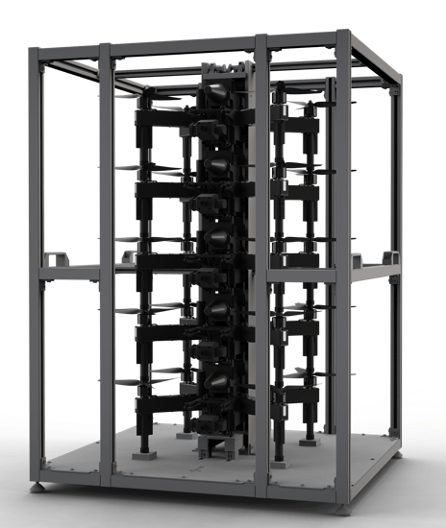
A defining feature of XAiDEN is its stackable architecture, allowing multiple drones to be stored and transported in a single deployment rack. This reduces logistical footprint, protects systems during transport, and enables rapid repositioning.
Rapid Swarm Deployment
Traditional unmanned systems often require lengthy preparation before launch. XAiDEN addresses this with a rapid swarm deployment system that allows multiple drones to be launched and assembled into formation within minutes.
Automated diagnostics run simultaneously across all units prior to launch. Once deployed, the drones autonomously organize into mission formations without requiring extensive operator control.
This capability is particularly valuable for time-sensitive targeting, where rapid deployment of a swarming loitering munition system can compress the sensor-to-strike timeline.
Software-Defined Swarm Intelligence
Another key aspect of XAiDEN is its software-defined swarm architecture. Mission behaviors, formations, and engagement logic are software-defined rather than hardware-fixed. This allows flexible adaptation to mission needs, whether reconnaissance, surveillance, or coordinated strike, and enables continuous capability upgrades through software updates rather than requiring new hardware platforms.
Operational Concepts
XAiDEN supports two primary operational modes.
High-Speed Infiltration focuses on rapid penetration toward pre-identified targets. The swarm launches, forms up, and moves toward the objective at high speed, enabling synchronized strikes against time-sensitive targets using coordinated loitering munition units.
Reconnaissance-Integrated Transit combines surveillance with movement. As the swarm advances, it searches for emerging targets and can redirect individual drones for engagement while others continue the primary mission.
The Human-in-the-Loop Framework
Although the drones operate autonomously for navigation, coordination, and tracking, lethal engagement requires operator approval. This human-in-the-loop design reflects current military doctrine, balancing the speed of automation with human judgment over rules of engagement.
Operators receive real-time reconnaissance feeds and system status updates through the ground control system, allowing them to make informed decisions without needing to manually control each drone.
A Shift Toward Swarm Architectures
XAiDEN illustrates a broader shift in defense technology, from individual platforms toward coordinated systems of autonomous assets.
Rather than relying on a single highly capable drone, swarm architectures distribute sensing, decision-making, and engagement across multiple cooperating units. Systems such as swarming loitering munitions demonstrate how coordinated autonomous platforms can increase resilience, flexibility, and adaptability in contested environments.
As unmanned systems continue to evolve, such architecture may play an increasingly important role in how militaries conduct reconnaissance, strike missions, and distributed operations.




Be the first to comment